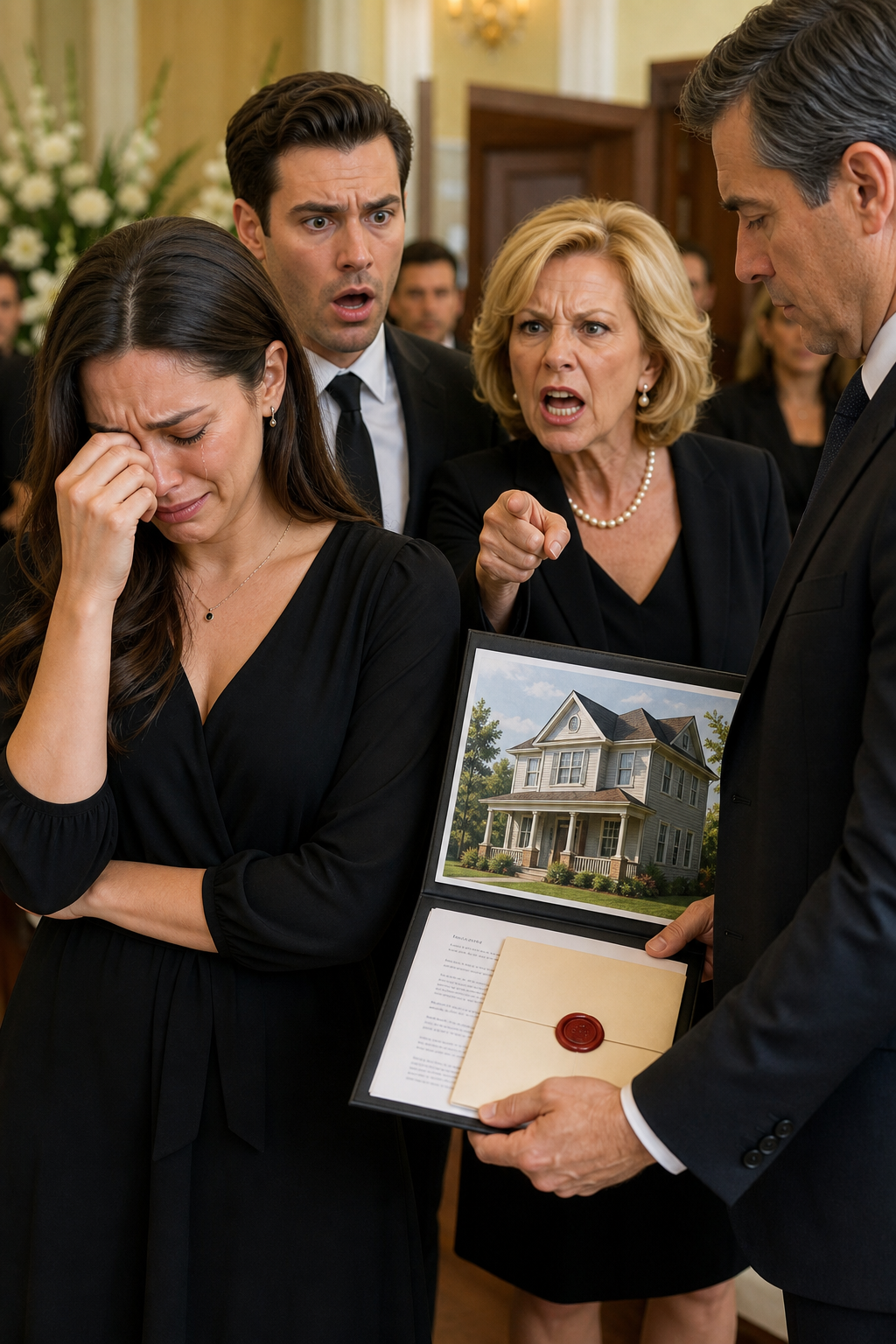
My Family Laughed as My Sister Knocked Me to the Floor and Shouted, "Eat on the Floor," at My Father's Birthday Dinner, Then My Phone Vibrated and the Room Went Silent
Priya, still standing in the doorway, stiffened.
"It's fine," I said. "Close the door, please."
Priya shut it.
Madison turned toward Mom. "You were supposed to fix this."
Mom remained silent.
That frightened Madison more than anything I could have said.
"What did you tell her?" Madison snapped.
"The truth would be a nice place to start," I said.
She whirled toward me. "You think you can des.troy everyone just because your feelings got hurt?"
"My elbow is bruised, not my feelings."
"Oh, please." She laughed, but the sound cracked halfway through. "You've been waiting for this. You always wanted to punish me because people love me more."
There it was.
Not an apology. Not denial. Ownership.
I folded my hands together on the desk. "Madison, you attempted to transfer $180,000 from a foundation account using a forged authorization."
Her face turned pale.
Mom whispered, "Maddie."
Madison ignored her. "It was going back."
"When Blake's deal closed."
"There is no deal."
Her mouth opened, then closed.
I continued, "There is debt. There are lenders. There are pending lawsuits. There are lies."
Her eyes flickered.
Blake hadn't told her everything. That much was obvious now. Madison knew enough to steal, but not enough to understand how deep the hole really was.
For a brief second, pity brushed against me.
Then she said, "You don't even need the money."
And the pity disappeared.
"That sentence is exactly why we're here," I said.
Madison's face twisted. "You've always acted superior because you built some boring logistics company and wear cheap black pants like you're better than everyone."
"I wore expensive black pants yesterday. You shoved them onto the floor."
Mom closed her eyes.
Madison slammed both hands onto my desk. "You will cancel the eviction. You will restore access to the accounts. You will tell everyone this was all a misunderstanding."
"You don't get to say no."
"I just did."
"You owe us!"
I rose slowly.
"I owe you nothing," I said. "But I will give you one option."
Her breathing came quickly.
"You sign a written admission that your statement about me at the luncheon was false. You reimburse the foundation's legal expenses within ninety days. You and Blake resign from every family-controlled committee funded by me. You stay away from my office, my home, and my staff. In return, I do not file the fraud report today."
Madison stared at me as though I had spoken another language.
Then she laughed again. This time, it sounded harsh and hollow.
"You won't file it. You're bluffing."
I reached for my phone.
Mom extended a hand toward me. "Claire—"
Madison lifted her chin. "Do it."
So I did.
I called my attorney, Mara Voss, on speaker.
Mara answered on the second ring. "Claire?"
"File the package with the bank's fraud division and send the civil complaint draft to Madison Harrington's attorney. Also notify the foundation board that Madison is permanently barred from any involvement."
Madison's mouth dropped open.
Mara said, "Understood. Do you want to proceed with the police report today as well?"
I looked directly at Madison.
Her confidence disappeared.
"Not today," I said. "Hold that for now."
"Documenting that instruction," Mara replied. "I'll confirm by email."
I ended the call.
Madison whispered, "You can't."
"My life will be ru!ned."
"No," I said. "Your life will be audited."
She recoiled as though the word itself was offensive.
Mom lowered herself back into the chair.
For several long seconds, nobody spoke.
Then Madison started crying.
Years earlier, that sound would have drawn me across any distance. Madison crying was the family alarm bell. Everyone rushed toward her. Everyone adjusted. Everyone gave up something.
But now I watched the tears slide down her cheeks and felt only a quiet, exhausted distance.
"You think this makes you strong?" she asked.
"No," I answered. "It makes me finished."
She wiped her face with the back of her hand, smearing her mascara. "The kids will hate you."
"Maybe. Or maybe someday they'll ask why their mother tried to steal from their aunt."
Madison's eyes flashed. "Don't you dare talk to them."
"I won't. I don't use children as shields."
Mom lowered her head.
That was the moment Madison realized she had lost the room.
Not because Mom had chosen me. Not exactly. Evelyn Mercer rarely chose anyone except herself. But she had measured the risk and realized Madison was no longer the safest investment.
Madison snatched her sunglasses from the desk.
"You'll regret this," she said.
I believed her. Not because she was right, but because she would spend years trying to make it true.
"Security will escort you out," I said.
She looked at me with pure hatred.
Then she walked away.
My mother stayed behind.
The rain outside had faded into mist. Morning light pressed pale silver against the windows. Across the river, office workers drifted like tiny shadows behind glass.
Mom looked older when she finally raised her face.
"I failed you," she said.
I didn't rush to comfort her.
That was new.
"Yes," I said.
The Apology Came Too Late
Her eyes filled once more. "I don't know how to fix it."
"You start by not asking me to absorb the cost."
She nodded once, though I could tell she hated the answer.
Thirty days later, my parents moved out of the house.
Dad left furious voicemails about betrayal, family legacy, and "forgetting where you came from." Mom texted me photos of half-packed boxes until I blocked her for a week. Madison posted vague quotes online about jealousy and spiritual warfare, then removed them after Mara sent a warning letter.
The public correction arrived on day forty-two.
It wasn't elegant. Madison wrote as though every word had to be pulled out of her with a rope.
To those present at the Mayfield Children's Benefit luncheon, I need to correct statements I made regarding my sister, Claire Mercer. Claire has not received financial support from our family. Any implication that she was dependent on us was false. Claire has provided significant financial support to members of our family, including me.
I read it once.
Then I forwarded it to Mara.
Blake filed for bankruptcy six months later. Madison sold her jewelry first, then her car, then the lake house she had claimed was "ours," even though every payment had come from a trust I dissolved. She moved into a rented townhouse in Naperville and told anyone willing to listen that she was simplifying her life.
My parents relocated to a condo in Oak Park. It was smaller than the house, but safe, clean, and entirely within their actual means.
For the first time in twenty years, Dad accepted a part-time consulting job. Mom joined a gardening club where nobody knew enough to admire her former life.
I no longer attended Sunday dinners.
There weren't any.
One year after the night Madison shoved me, I returned to the house alone.
It had stood empty for two months while contractors repaired the d@mage my family had always called "normal wear." Wine stains beneath rugs. A cracked marble countertop. Holes behind framed portraits. A basement filled with boxes labeled with my name, although none of the items inside belonged to me.
I walked through the dining room last.
The table was gone.
I had sold it.
In its place were open space, sunlight, and silence.
For a while, I stood exactly where I had fallen.
I expected to feel triumphant.
Instead, I felt light.
There is a difference.
Triumph needs an audience. Lightness only needs absence.
My phone buzzed.
A message from an unknown number.
It was Madison.
I almost deleted it without reading it, but curiosity won.
Claire, I'm not asking for money. I just wanted to say Mom told me you sold the house. I always believed you kept it to hold over us. Maybe you kept it because you hoped we'd become different people inside it. I don't know. I'm angry. I'm still angry. But I know I lied about you. I know I took things. I know I pushed you because I believed you'd never push back. That's all.
There was no apology.
But there was honesty.
Coming from Madison, that was far rarer.
I didn't type a reply.
Some messages don't require answers. Some doors don't need to be slammed shut. They simply stay closed until the person outside finally stops knocking.
Six months later, I sold the house to a young couple with twin boys and a golden retriever that slid across the polished floor during the showing. The wife cried in the kitchen because she said she could picture Christmas there. The husband apologized for her tears. I told him not to.
A house belongs with people who can love it without turning it into a throne.
At the closing, I signed the last document and felt no grief.
That evening, I treated myself to dinner at a small restaurant near the river. I sat at a corner table, ordered steak, and ate slowly. Nobody told me where to sit. Nobody watched my plate. Nobody laughed when I reached for my glass.
Halfway through dessert, my phone rang.
I let it ring twice before answering.
There was a brief pause.
"Claire," she said. Her voice sounded cautious. "I heard the closing went through."
She took a breath. "I'm not calling to ask for anything."
A quiet, bittersweet laugh. "I suppose I deserved that."
I said nothing.
"I've been seeing a counselor," she continued. "Your father too, though he insists it's for his blood pressure."
"I told her about the dinner."
My hand tightened around the spoon.
"All of it?" I asked.
"Yes," she said. "All of it."
Outside, the river reflected the city lights in broken streaks of gold.
Mom's voice grew softer. "She asked me why I didn't stand up when you fell."
I closed my eyes.
"And what did you say?"
"I said I didn't want to make things worse."
"That was always your answer."
"I know." Her breath trembled. "Then she asked who things became worse for."
For the first time that evening, my throat tightened.
Mom whispered, "I'm sorry, Claire."
The apology didn't repair everything.
But it arrived without an invoice attached.
"Thank you," I said.
She cried quietly on the other end. I didn't rescue her from the silence. I let her remain inside it, because sometimes silence is where truth finally finds enough room to stand.
When we ended the call, my dessert had melted a little around the edges.
I ate it anyway.
A week later, I bought a new dining table for my apartment. Small, walnut, round. Four chairs. No head seat.
Priya came over first, carrying flowers and inexpensive champagne. Jonah arrived after her with Thai food. Mara came later, still wearing her courtroom heels, and complained that my building's parking garage had clearly been designed by a sadist.
We ate crowded together, laughing about noodles, contracts, and office gossip.
At one point, Priya dropped a dumpling onto the floor.
Everyone froze for half a second.
Then she gasped dramatically. "I'll eat on the floor, I guess."
The table fell silent.
Then I laughed.
Not politely. Not cautiously. I truly laughed.
The others joined in, relieved, warm, and wonderfully human.
Priya leaned over and squeezed my hand.
I looked around my small table at people who didn't need my money to respect me, who didn't confuse kindness with debt, and who didn't mistake silence for permission.
For years, my family had taught me that love meant remaining seated no matter how many times someone pushed you down.
They were wrong.
Love is not the table.
Love is the person who reaches for you when you fall.
And if nobody reaches?
You brush yourself off.
You make one tap.
Then you build a room where nobody ever tells you to eat from the floor again.