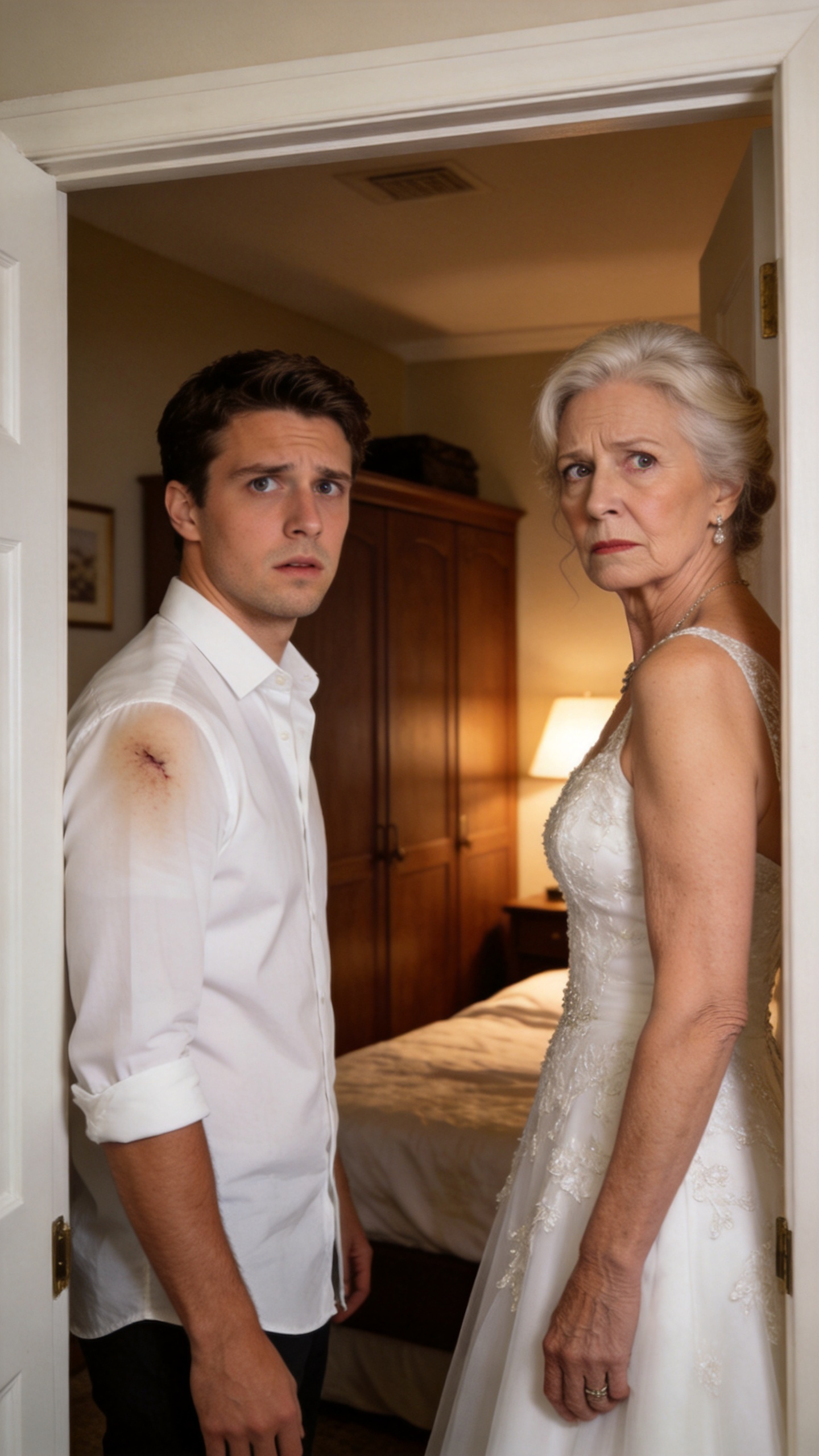
My Rich Husband's Daughter Showed Up at 11 p.m. with Her Spouse, Two Bulky Suitcases, and One Jaw - dropping Demand: They Were Moving In. Then She Gave Me Chores and Told Me to "Earn My Keep". I Just Smiled and Agreed. At 6:00 Next Morning, She Got the Shock of Her Life.
“No. You were gambling,” she said.
Tom slammed his palm on the table and said, “You spent money too!”
Lisa stepped back and said, “You wanted the apartment. You wanted the vacations. You wanted to go to the restaurants. Every month you said your father would help if things got tough.”
Mr. Harris's expression changed. That sentence seemed to hurt him more than anything Lisa had ever said to me.
She noticed it and said, “Dad, I never said—”
Tom laughed bitterly and said, “You said it all the time.”
“Shut up,” she said.
“You told me your father would never let you fail,” he continued.
“Shut up!” she shouted.
“You told me he’d eventually give you part of the family company,” he added.
Mr. Harris said, “There is no part of the company waiting for you.”
Lisa turned and asked, “What?”
“My estate plan doesn't transfer control of Whitmore Manufacturing to either of my children,” he explained.
She stared at him. Mr.
Harris had founded Whitmore Industrial Components at thirty - six and spent nearly three decades building it into a profitable regional manufacturer with more than eight hundred employees across Illinois, Indiana, and Wisconsin.
Lisa had always thought of it as an inheritance that was just waiting for her.
Mr. Harris went on, “Your brother has never assumed he will inherit management control either.”
The Morning of Reckoning
“But Ethan works there,” Caroline protested.
“He works there because he started in procurement, got promoted, and is now the vice president of operations,” Mr. Harris patiently explained.
“He’s your son,” Caroline insisted.
“Yes. And if he stopped performing well, the board would replace him,” Mr. Harris firmly stated.
Caroline shook her head in disbelief and asked, “What happens to the company when you die?”
“The controlling shares will go into a trust,” Mr. Harris replied.
“For who?” Caroline pressed.
“My grandchildren and charitable causes, depending on the situation,” Mr. Harris said.
She looked shocked and accused him, “You never told me.”
“You never asked. You just assumed,” Mr. Harris retorted.
Caroline sank into the nearest chair. It was just six thirty in the morning.
Less than eight hours earlier, she had entered the house thinking she could order me to hand - wash her clothes. Now she was realizing that her marriage, finances, and expected inheritance were all in an unstable state.
Martin, the lawyer, moved closer and said, “Caroline, we need to deal with two separate issues. First, Tom's possible unauthorized borrowing. Second, your current financial situation.”
She slowly nodded as she took in the information. Tom, on the other hand, looked furious and growled, “You’re all acting like I committed a huge crime.”
Martin calmly replied, “If you got credit using your wife’s identity or authorization without her consent, that could become a serious legal problem.”
“I had permission to manage our finances,” Tom argued.
“Managing household finances doesn't necessarily mean you have permission to take on debt in someone else’s name,” Martin countered.
Tom pushed his chair back and declared, “I’m not staying here for this.” He stood up suddenly.
Caroline looked at him and asked, “Where are you going?”
“Anywhere else,” Tom replied.
“You have nowhere else to go,” Caroline pointed out.
“Neither do you,” Tom shot back. That made them both quiet.
Tom headed toward the stairs. I spoke for the first time in a few minutes and said, “Your suitcases stay upstairs until we know if anything in this house belongs to us.”
Tom spun around and demanded, “You think I’m a thief now?”
“I think someone who secretly borrowed tens of thousands of dollars without proper authorization deserves to be treated with caution,” I firmly said.
Tom glared at me and then went upstairs.
Caroline stayed at the table. Mr. Harris slowly sat beside her. For once, she didn't pull away. She whispered, “Dad, what am I supposed to do?”
He looked at her for a long time and said, “The first thing you need to do is stop asking me to save you.”
Her eyes filled with tears. I thought she might have another outburst, but instead, Caroline nodded.
That morning, Martin helped her get all three credit reports. The situation was worse than Tom had admitted.
There were four personal loans, two credit cards Caroline didn't recognize, and a recently opened line of credit. The total unauthorized debt possibly related to Tom was about $112,000.
Caroline sat still while Martin wrote down the numbers. Mr. Harris didn't offer to pay the debt, and neither did I. It was the first real consequence she had faced in years.
By nine o’clock, Tom came downstairs dressed and carrying one suitcase. Caroline stood up and asked, “Where are you going?”
“My brother’s,” Tom said.
“Does he know?” Caroline asked.
“He will,” Tom replied.
“You’re leaving me with this?” Caroline accused.
“This marriage has been over for months,” Tom coldly said.
Caroline flinched at his words. Mr. Harris started to move forward, but she raised one hand and said, “No, Dad.”
She looked directly at Tom and asked, “Did you ever plan to tell me?”
He hesitated. That was enough of an answer.
“What would you have done if the investment had made money?” Caroline asked.
“I would’ve paid everything back,” Tom replied.
“And if it didn't?” Caroline pressed.
He didn't say anything. Caroline slowly nodded and said, “Go.”
Tom picked up his suitcase. At the front door, he turned toward Mr. Harris and said, “I hope you know your daughter is the one who spent half that money.”
Mr. Harris replied, “Then she’ll be responsible for the debt she actually owes.”
Tom turned toward me and said, “And you.”
I raised an eyebrow. “You think you won something,” Tom sneered.
“No,” I said. I glanced at Caroline. “I think everyone in this room is finally seeing the truth.”
Tom left. Eleven days later, the divorce papers were filed. Caroline couldn't go back to her old apartment because the landlord had already rented it to someone else. She stayed in the guest room under the thirty - day agreement.
Then something happened that I hadn't expected. She followed the rules. She didn't do it happily. She didn't do it smoothly. But she followed them. She made her own breakfast, did her own laundry, and cleaned the bathroom.
During the first week, she complained all the time. By the second week, she was mostly quiet. By the third week, she was waking up before seven every morning to look for a job.
Caroline had a communications degree but had spent years hopping between short - term jobs because she never really had to keep one. Mr. Harris refused to call anyone for her, and so did I.
Eventually, she found a job as an account coordinator at a logistics company in Oak Brook. The salary was much lower than what she was used to spending, but she took the job anyway.
One evening near the end of August, I found her sitting at the kitchen island with a calculator and a legal pad. She said, “I don't understand how people can live on this.”
I looked at the figures: take - home pay, rent, groceries, car insurance, and debt payments. I said, “Most people adjust their lives to their income.”
Caroline gave me a tired look and said, “I know how stupid that sounds.”
“I didn't say it sounded stupid,” I replied.
“You were thinking it,” she insisted.
“No. I was thinking you’re finally looking at the numbers,” I said.
Caroline looked down. After a moment, she quietly said...
A New Era of Understanding
“I was really mean to you,” Lisa said.
I kept quiet. I wasn't sure what to say at first.
She continued, “When Mom died, Dad was alone for years. Then you came along, and suddenly he was traveling again. He was renovating things and laughing more.”
“Did that make you angry?” I asked.
“It made me scared,” she replied.
“Scared of losing him?” I asked.
She shook her head. “Scared of becoming less important.”
There it was, the real reason. It wasn't really about money. Money had just become how she showed her fear.
She looked me straight in the eye and said, “That doesn’t excuse what I said.”
“No, it doesn't,” I simply said.
“I know,” she murmured.
There was a short silence.
Then she smiled awkwardly and said, “I also really thought Dad bought this house.”
“That was obvious,” I said with a small smile.
She let out a laugh. It was the first time I'd heard her laugh without any bitterness.
On September fifteenth, Lisa moved into a simple one - bedroom apartment in Downers Grove. Mr. Harris helped carry the boxes, but he didn't pay her deposit. She paid it herself.
Three months later, the investigators found that several accounts had been opened without Lisa's permission. She cooperated with the lenders and the authorities.
Tom disagreed with her side of the story, and the legal process dragged on. But the evidence was strong.
Her attorney thought she'd eventually be cleared of most of the disputed debt.
However, her real debts were another matter. She owed nearly forty thousand dollars on her own. She signed up for a repayment program and then sold the Mercedes.
At Christmas, she arrived at our house in a seven - year - old Toyota Camry. Mr. Harris stared out of the front window and asked, “Is that yours?”
Lisa grinned and said, “I paid cash for it.”
“How?” Mr. Harris wondered.
“I sold half the designer bags you bought me,” she said.
Mr. Harris laughed loudly.
Dinner that night was simple. There was roast chicken, potatoes, and green beans. Lisa brought dessert.
After dinner, while Mr. Harris and his lawyer, Mr. Mercer, argued about football in the living room, Lisa came into the kitchen as I was loading the dishwasher.
She handed me an envelope. I looked at it suspiciously and asked, “What’s this?”
“A list,” she said.
I almost laughed.
She gave me a little smile and said, “Open it.”
Inside was the original chore sheet she had given me months before. It still had all those crazy demands like “Breakfast at six,” “Fresh sheets,” “Bathroom cleaning,” and “Hand - washed clothes.”
But she had crossed out every line.
Underneath, she had written, “Things I never had the right to ask for.” Below that was written, “Things I owe myself: a job, a budget, independence, better judgment, and enough humility to never give another grown woman a chore list in her own house.”
I looked at her in surprise and asked, “You kept this?”
“I found it in my suitcase,” she said.
“I thought you threw it away,” I told her.
“I almost did,” she admitted.
She hesitated for a moment and asked, “Can I ask you something?”
“Yes,” I replied.
“Why did you say okay that night?” she asked.
I remembered her standing in the foyer beside those two huge suitcases, talking to me like I was hired help. I said, “Arguing with you at eleven o’clock wouldn't have solved anything.”
“So you were planning the six - o’clock surprise?” she asked with a certain look on her face.
“I wouldn’t call it a surprise,” I said.
She gave me a skeptical look and said, “There was a lawyer at breakfast.”
“Fine. It was a very well - organized breakfast,” I admitted.
She laughed. Then her expression softened and she said, “I deserved it.”
“You needed it,” I told her.
She nodded in agreement.
Just then, Mr. Harris appeared in the doorway and asked, “What are you two whispering about?”
Lisa looked at me. I looked at her. “Breakfast schedules,” I said.
Mr. Harris frowned.
Lisa burst out laughing. “What did I miss?” Mr. Harris asked.
“Nothing, Dad,” Lisa said.
She walked over and kissed his cheek. Then she picked up her coat and said, “I have work tomorrow.”
Mr. Harris looked at the clock and said, “It’s only nine.”
“I know. Some of us have jobs,” she teased.
He put a hand dramatically over his chest and said, “After thirty years running a manufacturing company, I’m hurt.”
Lisa smiled and said, “Goodnight, Dad.”
“Goodnight, sweetheart,” Mr. Harris said.
At the door, she looked back at me and said, “I?”
“Yes?” I said.
“I’ll bring breakfast next Sunday.”
“What time?” I asked.
She paused, then grinned and said, “Not six.”
The door closed behind her.
Mr. Harris walked into the kitchen and saw the old list in my hand. He asked, “She apologized?”
“In her own way,” I said.
He nodded and said, “You were right not to let me fix everything.”
“I know,” I said.
“You could pretend to be humble,” he joked.
“I could,” I said with a smile.
Outside, Lisa's Camry drove away from the curb. Months earlier, she had arrived with two huge suitcases, with a husband hiding a big financial problem, thinking everyone was there to make her life easy.
Now she left with fewer things, less money, no husband, and a lot more responsibility.
Strangely, she seemed more at ease.
I folded the old chore list and put it in the kitchen drawer. Not as a trophy, not for revenge. Just as a reminder of that one morning when the most important thing served at six o’clock wasn't breakfast. It was the truth.