He Threw Me Out of "His" Mansion. By Sunrise, the Files in My Briefcase Proved the House, the Company, and the Name on the Gate Were Never His.
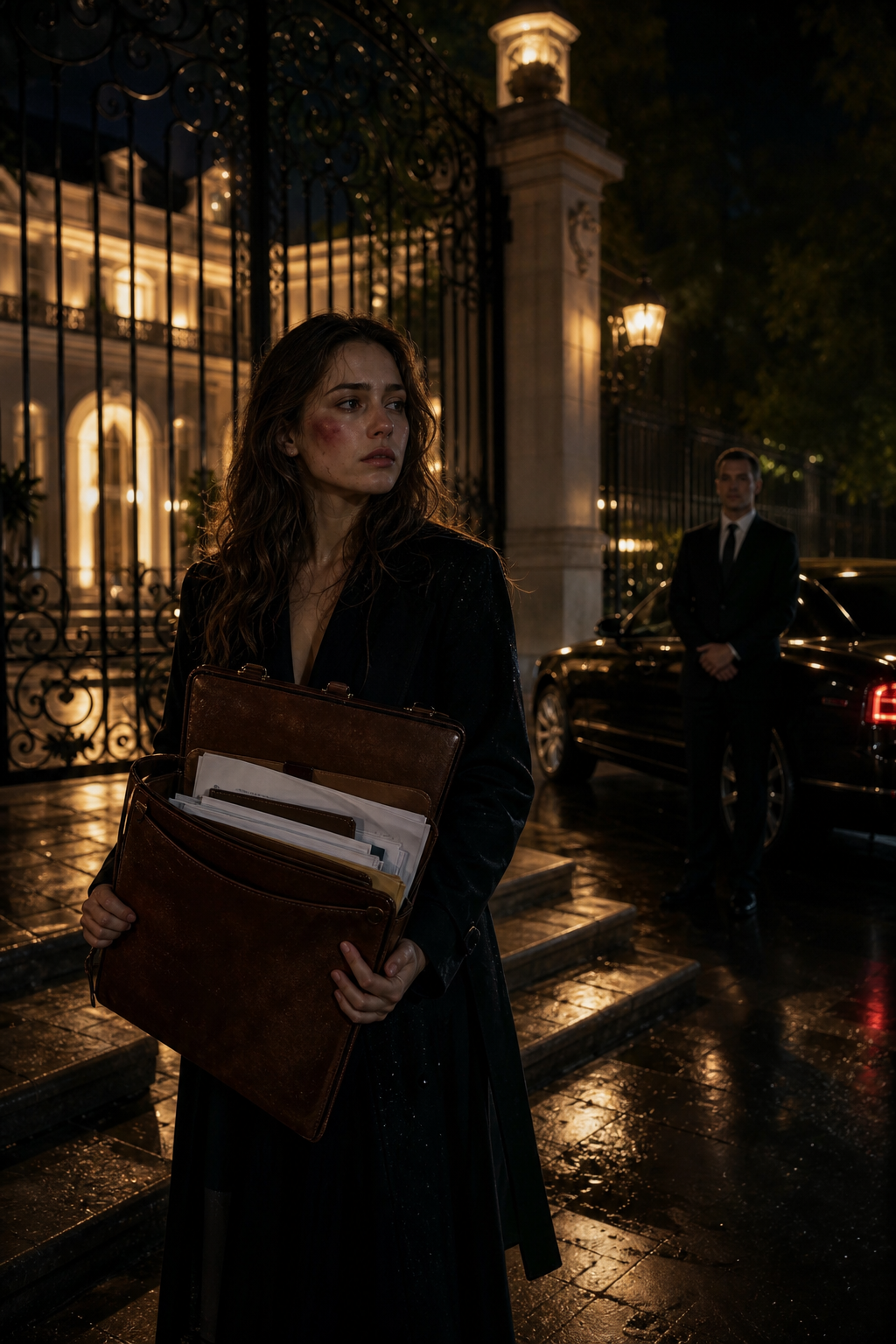
The cold outside felt gentler than the silence I left behind.
I stood on the front steps of the mansion for a moment, my cheek burning beneath the fading afternoon light. Behind me, the heavy oak doors remained closed, sealing in the people who had decided I was disposable.
Beyond the iron gates, the neighborhood looked exactly as it always had - quiet lawns, trimmed hedges, fountains whispering into ornamental ponds.
Nothing about the world seemed to understand that my life had just split into a before and an after.
My driver, Nolan, saw me before I reached the bottom step. His expression changed at once. He hurried around the car and opened the back door but he did not ask questions.
Nolan had worked for me long before Preston learned how to pronounce the names of the restaurants where he now liked to be seen.
"Downtown office, Ms. Blake?" he asked gently.
I touched my cheek, then looked back at the house.
"No," I said. "Take me to the Warwick."
His eyes flickered in the mirror. "Yes, ma'am."
The Warwick Hotel had been my quiet refuge for years. I used its conference rooms for discreet meetings, its private entrance when investors wanted anonymity
and its corner suite whenever I needed a place to think without Preston's voice carrying through the halls.
I had never imagined going there as a woman with one purse, one phone, and a wedding ring cutting into her palm.
Halfway there, my phone buzzed.
I watched his name appear, disappear, then appear again. On the fourth call, a message arrived.
Come back when you're ready to apologize. Mom is very upset.
I stared at the words until they blurred.
Something in me settled, not with anger, but with clarity. Anger shook. Clarity stood still.
At the hotel, the manager recognized me immediately and guided me through the private corridor. In the elevator mirror, I saw the red mark along my cheek and the small crescent of dried blood in my palm.
For a second, I barely recognized the woman looking back.
Inside the suite, I washed my hands slowly. The water turned pink for a moment, then clear. I removed my wedding ring and placed it on the marble sink ledge. The diamond caught the light beautifully, as if beauty had anything to do with truth.
By the time my attorney arrived, the sky had turned violet over the city.
Margaret Hale entered without ceremony, carrying a leather briefcase and wearing the same calm expression she used when negotiating contracts worth more than most people's homes. She had been my lawyer since I was twenty-six
when I sold my first software company and learned how quickly people smiled when they wanted access to money.
She stopped when she saw my face.
"I need you to file tomorrow morning."
"For everything we prepared."
Margaret set her briefcase down carefully. "Are you certain?"
I looked toward the window, where the city lights flickered awake one by one.
"I should have been certain a long time ago."
She nodded, then opened the briefcase. "I brought copies of the property records, holding company documents, transfer history and the private account statements. We can petition for exclusive possession immediately.
Given what happened today, we may also request temporary protective conditions."
"I don't want spectacle," I said.
"I don't want reporters. I don't want a dramatic scene at the house. I just want the truth put where no one can pretend not to see it."
Margaret's eyes softened. "That is often more powerful than spectacle."
For the next two hours, we reviewed documents I had hoped never to use. The mansion deed belonged to Bellweather Holdings, a company I owned outright.
Preston's business had received quarterly infusions from a consulting agreement with my family trust. Evelyn's monthly allowance had been routed through Brooks Strategic Group but the source was mine.
Even the charitable foundation Evelyn liked to parade at luncheons existed because I had funded it anonymously after Preston begged me to help him appear more established.
"Did he ever know how much?" Margaret asked.
"He knew enough not to ask questions."
"Because ignorance is one thing. Willful blindness is another."
The phrase sat between us.
It described almost everyone in that room.
The relatives who looked at their teacups. Preston, who heard his mother humiliate me and chose silence until he chose violence. Evelyn, who mistook kindness for dependence because it pleased her to believe I had nothing.
Margaret slid one final folder toward me.
"This arrived from the forensic accountant last week."
I had almost forgotten. Months earlier, after noticing irregular withdrawals connected to Preston's company, I asked Margaret to investigate quietly. At the time, I told myself I was being cautious, not suspicious.
"Transfers from Brooks Strategic Group to a private account under an entity called Fairlake Advisory."
"I've never heard of it."
"Neither had we. It appears to be controlled by someone named Audrey Blake."
The name meant nothing at first. Then a memory stirred: a woman in a cream dress at Preston's fundraiser, laughing softly beside the auction table while Preston leaned close to hear her over the music.
"She's a consultant," I said slowly. "Preston told me she helped with corporate partnerships."
Margaret's expression did not change, which told me enough.
"Just under four hundred thousand dollars over eighteen months."
The room seemed to tilt, but only slightly. Perhaps there was a limit to how many betrayals the heart could absorb in one day before it became strangely practical.
"Yes. Some of which originated from your capital contributions."
For the first time since leaving the mansion, I almost laughed.
Not because anything was funny.
Because the perfect family portrait above the fireplace had cracks behind the frame.
That night, I did not sleep much. I lay in the hotel bed while traffic murmured far below and remembered the beginning of my marriage.
Preston had been different then, or perhaps I had only needed him to be. He was charming in the earnest way of someone not yet successful enough to be arrogant. He remembered small details. He brought coffee to my office when I worked late.
He told me I was brilliant without sounding threatened by it.
On our third date, he admitted his mother could be "a lot."
"She's had a hard life," he said then. "She worries people will leave."
I had felt compassion for Evelyn before I ever felt resentment. Preston's father had died when Preston was young, leaving debts and a half-finished house. Evelyn had turned struggle into identity.
By the time I met her, she wore hardship like a crown and used it to demand tribute.
At first, I gave it willingly.
I paid off the debt Preston said embarrassed her. I arranged the driver because her knees hurt. I funded the allowance because Preston said providing for his mother mattered to him, and I loved that he cared.
Love, I realized in the dark, can become a room where people move the walls while you are asleep.
By morning, my cheek had faded from red to a faint shadow. My resolve had not faded with it.
Margaret filed just after nine.
At ten, Preston called seventeen times.
At ten-thirty, Evelyn called once.
I let both go unanswered.
At eleven, Margaret texted: Service completed.
I imagined the scene with unwilling precision. Preston opening the door expecting flowers, perhaps an apology, perhaps me with swollen eyes and a suitcase.
Instead, a process server standing on the porch with an envelope that would introduce him to the architecture of his own delusion.
The first message arrived three minutes later.
Emily, this isn't funny. You can't claim the house.
Then, after a long pause:
I placed the phone face down.
Across from me in the suite's sitting room, my younger sister, Grace, watched quietly from the sofa. She had arrived with a paper bag full of pastries and the fierce expression she had worn since childhood whenever someone hurt me.
"You don't have to read those," she said.
"You're thinking about them."
Grace reached for my hand. "I wish you had told me how bad it was."
I looked down. "Being the woman everyone warned me not to become."
Grace's eyes filled, but she did not cry. That was one of her gifts - making room for my feelings without crowding them with her own.
"You became generous," she said. "They became comfortable."
The simplicity of it undid me more than sympathy would have. I covered my face, and for the first time since Preston struck me, I cried.
Not loudly. Not dramatically. Just enough for the grief to leave my body in quiet waves.
Grace moved beside me and held my shoulder.
When the tears passed, I felt hollowed out but steadier.
"Now I decide what kind of person I am without them telling me."
By midafternoon, Preston's attorney contacted Margaret. By evening, the tone had shifted from outrage to concern. By the next morning, Preston requested a private meeting.
Margaret advised against it.
Grace strongly advised against it.
Even Nolan, who rarely volunteered opinions, said, "People show themselves once. The second time is usually just a performance."
But I agreed to meet Preston in Margaret's conference room, with Margaret present behind the glass partition and every word recorded with consent. I needed to see whether remorse lived anywhere beneath his panic.
Preston arrived wearing yesterday's confidence badly. His suit was expensive, but wrinkled at the cuffs. His hair, usually perfect, looked as though he had run his hands through it too many times. When he saw me, his face changed.
For one brief second, I thought he might cry.
Then he looked toward the glass wall and straightened.
"Emily," he said. "This has gone too far."
I sat at the table. "That's an interesting opening."
He lowered himself into the chair opposite me. "I'm not saying what happened was okay."
"I'm saying families fight. People say things. You know how Mom gets when she feels disrespected."