I Was Handcuffed At A Virginia Gas Station Because Two Cops Refused To Believe My Military Uniform And Government SUV Were Mine
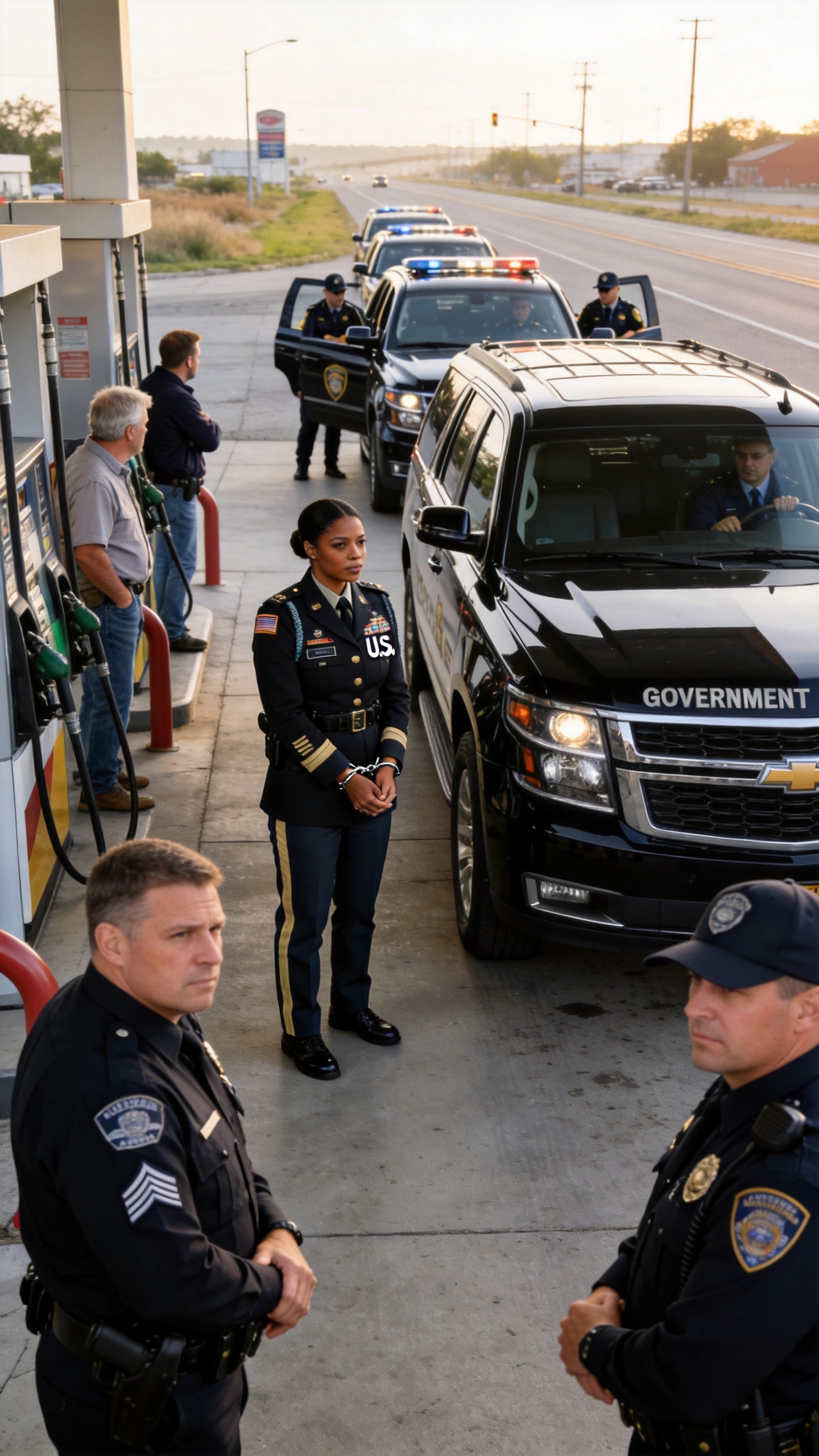
The Cuffs Closed In Front Of Everyone
The handcuffs snapped shut around my wrists before the sun had fully risen.
Cold steel.
Unforgiving.
Pulled deliberately tighter than necessary.
My name is General Regina M.
Cal, United States Army.
Throughout my career, I have commanded troops in active combat zones, delivered briefings to cabinet-level officials, and stepped into secure rooms where a single sentence could alter military strategy and influence the course of national decisions.
I have spent decades carrying responsibilities measured not in paperwork, but in lives. Yet at exactly 7:12 on a quiet suburban morning outside a gas station in Virginia, none of that mattered.
At least not to Sergeant Alan Cole.
To him, I wasn't a commanding general.
I wasn't a decorated officer. I wasn't a public servant entrusted with national security. I was simply a Black woman standing beside an expensive government-issued SUV. And in his mind, that was all the evidence he needed.
"Hands behind your back," he barked. "They already are," I replied, keeping my voice calm and controlled. Officer Henkins stood beside the open driver's door of my vehicle.
In his hand was my Pentagon-issued phone, which he examined as though he had just recovered stolen property from a crime scene.
"This government property?" he asked.
"Yes." Cole let out a short laugh.
"Of course it is." I glanced around the gas station parking lot.
The fuel pump clicked softly beside me. Bright coffee advertisements hung in the convenience store windows. A cashier stood frozen behind the glass, watching the scene unfold with wide eyes.
Everything about the setting seemed painfully ordinary.
That was what made it so dangerous. "Sergeant," I said evenly, "my credentials are clipped to my belt. Verify them. " Cole stepped closer until I could smell the stale coffee on his breath. "You don't get to tell me how to do my job." "No," I answered.
"But procedure does." Something hardened in his expression.
I saw it happen instantly.
The shift.
The moment professionalism disappeared.
That was when the insults began.
He stopped addressing me as an officer. He stopped addressing me as a citizen deserving basic respect.
He certainly didn't acknowledge my rank.
Instead, he used words intended to diminish me.
Words designed to strip away dignity. Words chosen specifically to drag a person backward through generations of history and prejudice. Words meant to make me feel smaller in my own country.
I refused to react.
I stared straight ahead.
Officer Henkins chuckled from beside the SUV.
"The station can figure her out," he said.
"You have no probable cause," I replied.
Cole shoved me toward the patrol car. A sharp burst of pain shot through both arms as the cuffs dug deeper into my wrists.
"You're being detained for possession of suspected stolen government equipment and impersonating military personnel." "My identification is attached to my belt." "Fake." "My vehicle registration is federal." "Stolen." "My phone can verify my command." Henkins lifted the device slightly and smirked. "Then I guess you should've held on to it. " For a brief moment, silence settled over the parking lot.
Then I heard it.
A low rumble.
Distant at first.
Growing louder by the second. The sound rolled across the pavement and echoed between the gas pumps.
Cole turned his head toward the street. A black SUV bearing government plates entered the lot at speed, tires gripping the asphalt as it made a hard turn toward us.
A second black SUV followed immediately behind it.
Then a third.
The atmosphere changed instantly.
Cole's hand loosened around my arm.
His confidence wavered. The smug certainty that had defined every word coming out of his mouth suddenly began to crack. And for the first time since he had approached me that morning, I saw something entirely different in his eyes.
Fear.
Real fear. Sergeant Cole believed he had stopped a woman with no influence, no protection, and no one coming to her defense.
He thought he had found an easy target.
He thought there would be no consequences. What he didn't understand was that the phone he had taken from my cup holder wasn't just a government device.
And what he certainly didn't realize was that the moment he seized it, it had already transmitted a signal he had absolutely no power to stop.
The handcuffs closed around my wrists before sunrise.
Cold steel.
Too tight.
Deliberate.
My name is General Regina M.
Cal, United States Army.
The Convoy Arrived Before They Could Rewrite It
I have commanded soldiers in combat zones, briefed cabinet officials, and walked into rooms where one wrong word could shift the weight of a nation.
But at 7:12 on a quiet suburban morning outside a gas station in Virginia, none of that mattered to Sergeant Alan Cole. To him, I was a Black woman beside an expensive government SUV, and that was enough.
"Hands behind your back," he snapped. "They already are," I said, keeping my voice level. Officer Henkins stood at my open driver's door, holding my Pentagon-issued phone like it was stolen jewelry.
"This government property?" "Yes." Cole laughed.
"Of course it is. " I looked at the pump, the coffee posters in the window, the clerk frozen behind the glass. The whole scene felt absurdly ordinary for something so dangerous.
"Sergeant," I said, "my credentials are clipped to my belt. Verify them." He leaned close, breath smelling of cheap coffee. "You don't get to tell me how to do my job." "No. But procedure does." His face changed.
That was when the insults started.
He did not call me by my rank.
He did not call me ma'am. He called me things meant to drag me backward through history, things meant to make me smaller in my own country.
I stared straight ahead.
Henkins chuckled.
"Station can sort her out." "You have no probable cause," I said.
Cole shoved me toward the patrol car.
Pain flared up both arms. "You're being detained for possession of suspected stolen government equipment and impersonating military personnel." "My ID is on my belt." "Fake." "My vehicle registration is federal." "Stolen." "My phone can verify my command." Henkins lifted it and smirked. "Then I guess you should've held on to it." A low rumble entered the lot.
Cole glanced over his shoulder. A black SUV with government plates turned in hard from the street, tires biting the pavement.
Then another followed behind it.
Cole's grip loosened. And for the first time, I saw fear cross his face. Cole thought he had stopped a woman with no witnesses and no power.
But the phone he took from my cup holder had already sent a signal he could not stop.
The rest of the story is below
The Proof Was No Longer Hidden
The first SUV stopped so close to Cole's cruiser that its front bumper nearly touched the push bar.
Four doors opened at once. Men and women in dark suits stepped out with the kind of coordination that makes civilians step back before they understand why. One wore a lapel pin from the Department of Defense.
Another had a badge on a chain.
The third I recognized immediately.
Colonel Marcus Avery, Army Criminal Investigation Division. His eyes went from my cuffed hands to Cole's grip on my arm.
"Remove the restraints," Avery said. Cole straightened, trying to recover the voice that had sounded so powerful ten seconds earlier.
"This is an active police detention." Avery walked closer. "You are detaining a four-star general of the United States Army without cause while in possession of federal communications equipment. Remove the restraints." Henkins swallowed.
Cole did not move.