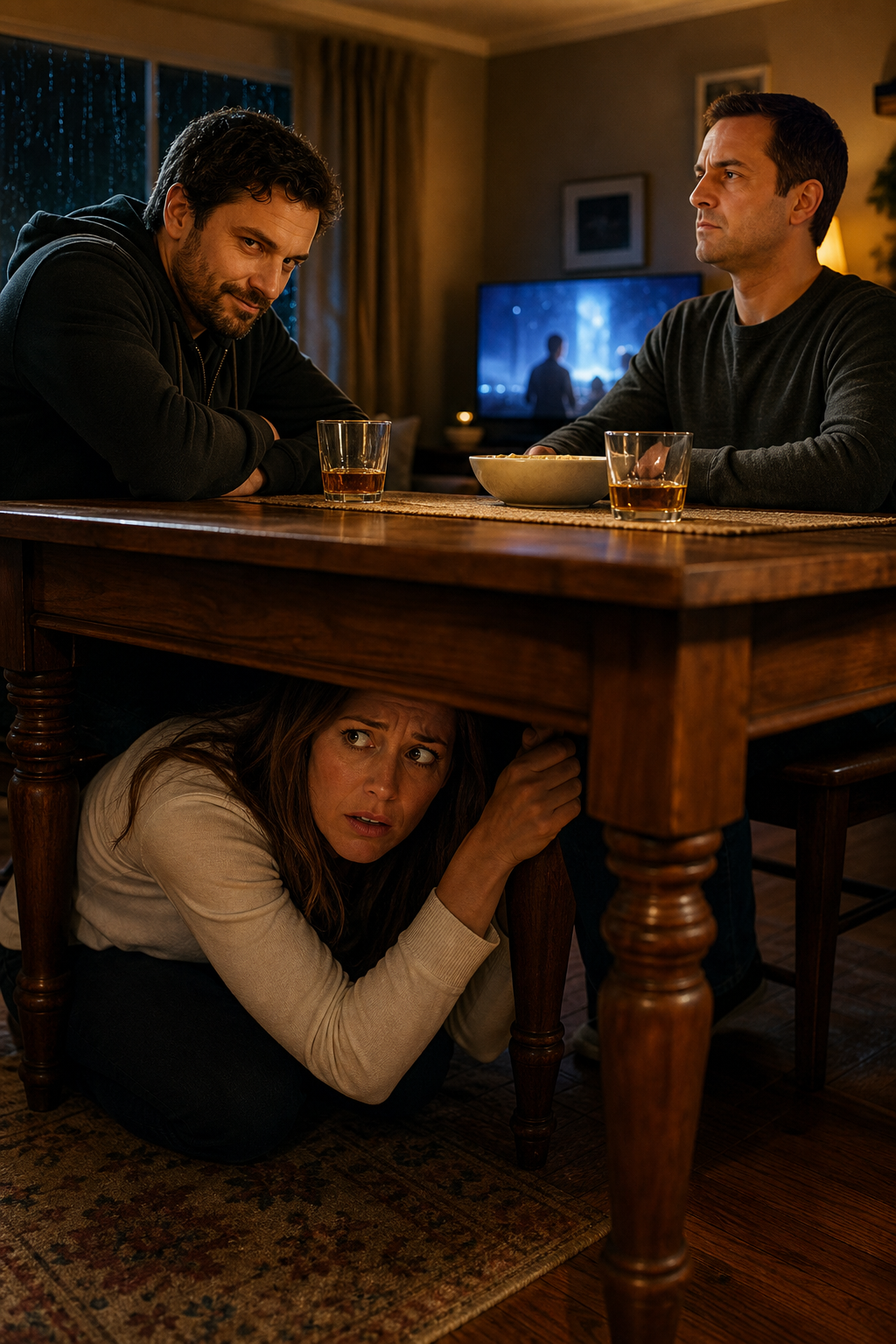
My Little Girl's Fever Hit 104, But My Mother-In-Law Blocked the Door and Told Me to Keep Smiling for Her Dinner Guests. "Stop Making This Family Look Bad," She Said. Then the Records She Never Knew I Kept Changed Everything
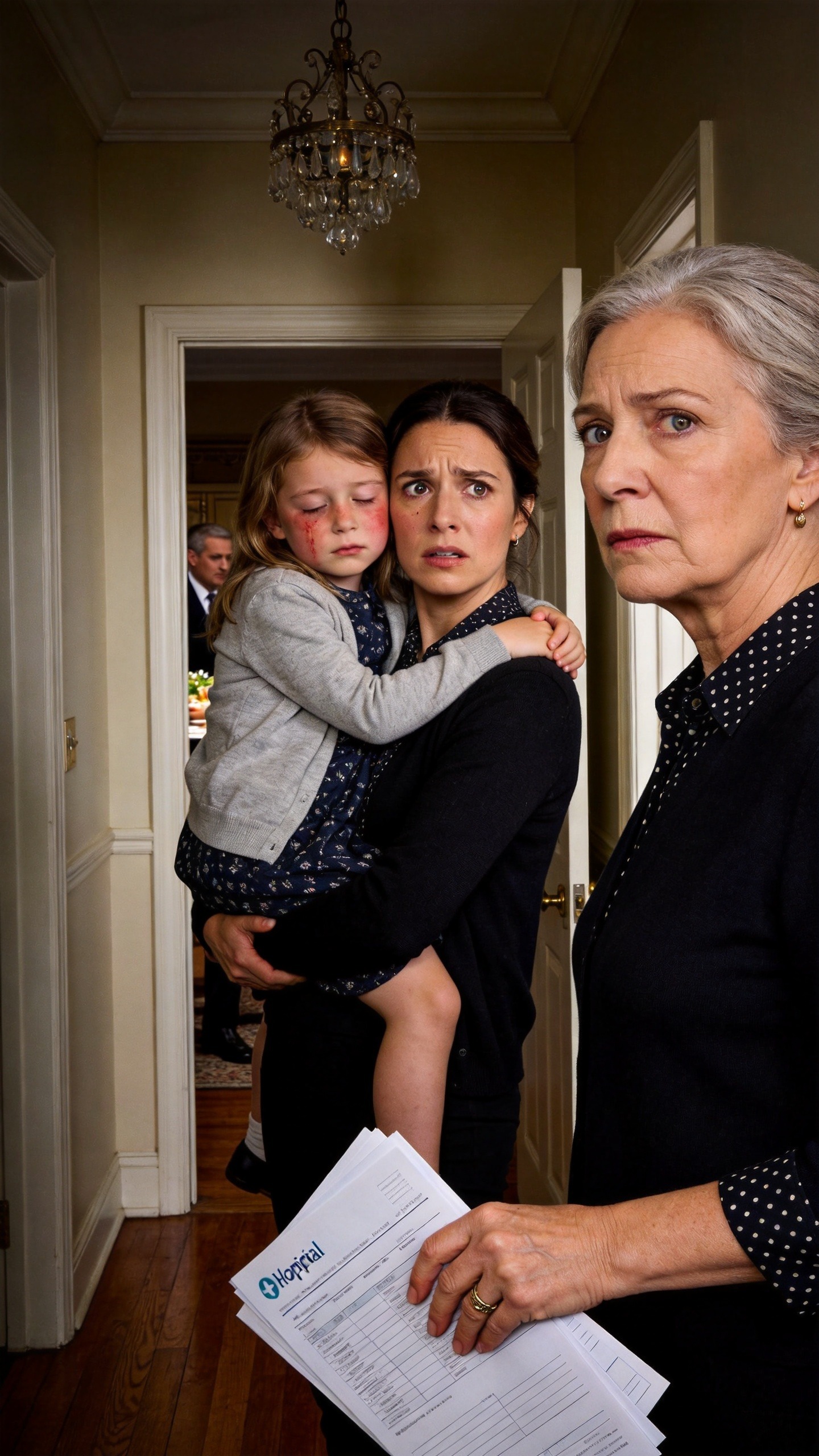
The thermometer read 104.1, and my mother-in-law was still asking whether the fish course had been served.
For one strange second, I thought I must have misunderstood her.
My daughter, Lena, was four years old. She was curled against my shoulder in a damp nightgown, burning so hot that the blanket around her felt warm in my hands.
Her lips had gone dry. Her eyes kept slipping shut. When I tried to help her sip water, she swallowed once and turned her face into my neck.
"Mommy," she whispered, "I'm so tired."
That was the moment the room changed for me.
Downstairs, the house was full of music, wine glasses, expensive perfume, and people laughing under the chandelier. Upstairs, my child was fading in my arms.
I grabbed my keys from the console table and walked toward the front door.
Corinne, my mother-in-law, stepped into the hallway before I could reach it.
She was wearing a wine-colored silk dress and pearls, her silver hair pinned in a perfect twist. She did not look at Lena. She looked at my sweater, my flats, and the blanket as if I had carried dirt into her party.
"Where do you think you're going?" she asked.
"Urgent care," I said. "Her fever is too high."
Corinne glanced toward the dining room. "Guests are arriving. Grant's uncle brought investors tonight. You are supposed to supervise the kitchen."
"Move."
Her eyebrows rose. She hated hearing her name without a please attached.
"It is a fever, Mara. Give her medicine and let her sleep. Children do not require the whole household to lose its dignity."
Then my husband came out of the study, adjusting his cufflinks.
Grant looked at our daughter. Then he looked past me toward the dining room.
"Not tonight," he said.
I waited for fear to appear in his face. I waited for him to become Lena's father before he became Corinne's son.
He did not.
I remember the front door more clearly than any face in that hallway.
It was black lacquer with a brass handle Corinne polished before every party, as if the door itself might impress the right person.
My keys were in my palm. Lena's breath was shallow against my collarbone.
Grant kept his body between us and that handle.
He did not raise his voice. That was part of what made it so ugly.
He spoke the way he spoke to junior employees when he wanted them to feel grateful for being corrected.
"You are tired," he said. "You are panicking. Give her to the nanny for half an hour and compose yourself."
"The nanny went home sick yesterday. You know that."
Corinne made a small clicking sound with her tongue.
"There is no need to recite household inconveniences in the foyer."
Lena stirred in my arms.
Her lashes were wet. Her skin smelled faintly of children's fever medicine and the lavender soap she liked because the bottle had a moon on it.
"Daddy?" she murmured.
Grant looked at her then, finally.
For one breath, I thought the spell would break.
Then someone called his name from the dining room.
He turned his head.
That tiny movement did more than any cruel sentence could have done.
It told me exactly where our daughter ranked in his emergency.
In the dining room, someone laughed too loudly at something Grant's uncle had said.
The sound floated down the hallway with the clink of silverware and the careful voice of the pianist Corinne had hired for the evening.
She had spent three weeks making that dinner feel like a coronation.
The flowers had to be white because, according to her, color looked provincial.
The seating chart had been rewritten four times because one investor's wife could not be placed near a cousin who drank too much.
Even the staff had been instructed to call me Mrs. Vale in front of the guests, though Corinne never did.
To her, I was Mara when she wanted something paid for and that woman when she thought I was out of earshot.
Earlier that afternoon, Lena had been sitting on the kitchen stool with her cheek against the cool marble.
She had tried to color while the caterers carried trays around her, but her little hand kept slowing, the purple crayon rolling from her fingers.
I had touched her forehead and felt heat gathering there like a warning.
Corinne had seen me reach for the thermometer.
"Children sense attention," she said, not looking up from the place cards. "Do not encourage a performance."
By six, Lena had stopped asking for juice.
By seven, she was shivering.
By the time the thermometer showed 104.1, every polite rule in that house had become noise.
The Doorway
"She has a 104-degree fever," I said.
Grant's jaw tightened. "Then give her medicine. My uncle is here. This dinner matters."
"Not more than she does."
I tried to step around him. He moved with me, blocking the door.
Behind him, Corinne's mouth curved with the smallest satisfied smile.
"If you leave tonight," Grant said, "do not expect to walk back in as if nothing happened. This is our home, Mara. Our roof. Our life."
Our roof.
The words settled over the marble floor, the imported rugs, the art I had bought, and the wine room I had paid to build because Corinne wanted to entertain properly.
Grant said our roof with the confidence of a man who had never signed the deed, paid the taxes, or asked where the money came from.
I shifted Lena higher in my arms. Her skin was still burning.
"This house is mine," I said quietly.
Both of them went still.
"The deed, the accounts, the company that pays for these parties, and the monthly transfer that keeps this household running. All of it is mine."
Corinne's face tightened. "This is not the time for whatever little point you think you are making."
"No," I said. "It is exactly the time."
Then I walked between them.
Grant reached for my elbow. I pulled away so sharply that my bracelet scraped my wrist.
"You are making a scene," he hissed.
"No," I said, opening the front door. "I am taking our child to a doctor."
The cold night air hit Lena's flushed cheeks. A young server followed me out and helped open the car door. He looked more frightened for my daughter than her own father had.
That detail stayed with me.
In the car, I kept apologizing to Lena even though she was too drowsy to answer.
"Almost there, sweetheart. Stay with me. Mommy is driving. We are almost there."
The streets near the mansion were lined with winter hedges and quiet security lights.
Everything outside looked orderly.
Inside the car, my hands were shaking so hard that I had to grip the wheel at the bottom to keep from swerving.
At the urgent care desk, the nurse took one look at Lena and stopped asking for insurance first.
That was when fear became official.
A stranger understood in three seconds what my husband and his mother had dismissed for hours.
The nurse called another nurse. Then a doctor. Then the word hospital entered the room.
Lena whimpered when they took her temperature again.
"I want my bed," she said.
I kissed her hot hair.
"I know. I know, baby."
The doctor did not dramatize anything, which somehow made it worse.
He spoke gently about dehydration, a stubborn infection, and the need for monitoring because small children could decline quickly when fever stayed that high.
He asked when symptoms started.
I gave the timeline.
When I said I had been delayed leaving the house, his pen paused above the chart.
He did not comment.
He wrote it down.
That note became the first line in a file Corinne never imagined would exist.
What They Thought I Was
I drove to urgent care with one hand on the wheel and the other reaching back whenever Lena whimpered.
At the clinic, they sent us onward to the hospital. Dehydration, infection, monitoring. Words that sounded clinical until they were attached to the child whose hand was wrapped around my finger.
Grant texted twelve times before midnight.
Where are you?
You embarrassed my mother.
People noticed.
Answer the phone.
Corinne sent two messages.
One said I had behaved disgracefully.
The other said a proper wife knew how to manage a child's discomfort without humiliating the family.
I read them beside Lena's hospital bed while the monitor blinked blue in the dim room.
Then I called Hale Bennett, the attorney who had handled my business affairs for years.
He answered on the second ring.
"Is Lena all right?" he asked first.
That almost broke me.
"She is being treated," I said. "I need you to begin separation paperwork tonight."
Hale was silent for half a breath. Then his voice changed into the precise calm I knew from contract rooms.
"Tell me what you need."
"Exclusive use of the house transferred away from Grant as quickly as the court allows. Freeze every household card except staff payroll and essential utilities. Audit every vendor account. Review every access request connected to Northline Homes."
"You are certain?"
I looked at my daughter, asleep with fever-pink cheeks and an IV taped to her hand.
"I am finished asking people to care.
Around two in the morning, the hospital hallway settled into that exhausted quiet where every sound feels too sharp.
A vending machine hummed by the elevators. A nurse's shoes squeaked past the door. Somewhere, a baby cried and was soothed.
Lena slept in short stretches.
Every time her forehead cooled a little, I felt my lungs open.
Every time the monitor beeped, I looked up.
Grant called again and again until I turned the phone face down.
Then the messages changed.
My uncle asked where you went.
Mother is humiliated.
You always choose the worst possible moment.
None of them asked for the room number.
None of them asked what medication she had been given.
At 3:17 a.m., Corinne texted: You have always needed an audience for your sacrifices.
I stared at that sentence until the words stopped looking like language.
Beside me, my daughter slept with tape on her small hand because an IV had to be secured to skin that still had traces of pink marker from preschool.
An audience.
That was what Corinne called a mother taking a feverish child out of a party.
I took screenshots before the messages could be deleted.
I forwarded them to Hale.
Then I opened the notes app and wrote down everything I remembered: the time, the thermometer reading, the words in the hallway, Grant's hand near my elbow, Corinne's face when the door opened.
I wrote until my thumb cramped.
By dawn, I had a record.
By dawn, I also had something quieter and more dangerous than anger.
I had clarity."
The Records
I had built Northline Homes before I met Grant.
My mother died when I was young, and my grandmother raised me in small apartments where heat failed in winter and every bill had to be studied before it was opened.
She used to tell me, "Own things one day, Mara. Do not borrow safety from people who can take it back."
I listened.
By thirty-six, I owned rental buildings, medical office units, and a small portfolio that kept growing because I understood quiet numbers better than noisy promises.
Grant came from a family name that still opened doors, even though there was little money left behind it.
When we married, I bought the mansion through my company. I kept the deed in my name, the records separate, and the operating accounts clean.
I did it because clear paperwork does not ruin love unless love depends on confusion.
For years, Corinne called it family money.
Grant called it our life.
I called it what it was: a managed expense paid by a company neither of them owned.
Northline had not made me glamorous.
It had made me disciplined.
There were years when I ate dinner standing over a sink because another building had a burst pipe and I had to meet the plumber before sunrise.
There were years when people assumed Grant was the one with the money because he knew which fork to use at charity lunches.
I let them assume it.
I thought privacy was protection.
I thought separate accounts, clean deeds, and careful tax files were enough.
What I had not understood was that privacy gave Corinne room to rewrite the story in public.
At her table, Grant was generous for opening his family home.
I was fortunate for being accepted into it.
The staff knew the truth because they saw the invoices.
The lawyers knew the truth because they drafted the entities.
But guests saw marble, portraits, and Grant's practiced ease, and they believed the old family still owned what the old family only occupied.
Corinne encouraged that belief like a gardener tending roses.
She introduced me as Grant's wife long before she used my name.
She corrected my menu choices in front of caterers.
She once told a florist to send the bill to the family office, though the family office was my controller, my payroll, and my signature.
I used to laugh it off because the paperwork was clear.
That night taught me paperwork protects assets.
It does not protect a child unless you are willing to make people face it.
By sunrise, Lena's fever had dropped. By noon, she had eaten applesauce and asked whether her stuffed rabbit was mad at her for leaving it behind.
I did not take her back to the mansion.
Hale's assistant booked us into a quiet hotel near the lake. Clothes, medicine, crackers, and a toothbrush with stars on the handle were waiting when we arrived.
Forty-eight hours later, the first court request was filed.
It included the hospital record, Grant's texts, Corinne's messages, the blocked exit, and the interference with medical care.
Then Hale called with the part I had not expected.
"Mara," he said, "someone has been looking for a path into your company."
Hale moved quickly because that was his gift.
By midmorning, he had asked for the hospital discharge plan, the pediatric recommendation, every message from Grant and Corinne, and copies of the house ownership records.
He did not waste time asking whether I wanted to calm down.
He knew me well enough to hear that I had become calm already.
His assistant, Nora, called with practical questions.
Did Lena need fever reducers at the hotel?
Would I authorize a security service to collect her clothes and medication from the mansion?
Was there a spare stuffed rabbit in the car, or should she buy one that looked close enough for a sick four-year-old not to notice at first?
That last question made me cry in the hospital bathroom.
Not because of the rabbit.
Because a stranger in Hale's office had thought more carefully about Lena's comfort than her grandmother had.
When security went to the mansion, Grant refused to open the nursery at first.
He said I was being theatrical.
The guard called Hale. Hale called Grant's attorney. Ten minutes later, the door opened.
Lena's rabbit arrived in a sealed evidence bag because the security team had already been instructed to document every exchange.
I cut the bag open with hospital scissors.
Lena tucked the rabbit under her chin and sighed.
That sound steadied me more than any legal document could.
The Attempt
Corinne had contacted a law office through a friend.
That office had drafted a theory claiming Grant might have an interest in the mansion and parts of Northline because he lived there, entertained there, and had benefited socially from the property.
It was weak, Hale said.
But that was not the worst of it.
A bank had rejected an attempt to add Grant as an authorized signer on Northline's primary operating account. The signature block used my name.
My hand went cold around the phone.
"Did Grant know?"
"We cannot prove that yet," Hale said. "But the timing matters."
The dinner. The investors. Corinne's insistence that I stay in the kitchen. Grant's anger when I refused to behave in front of his guests.
Suddenly the night looked different.
They had not merely wanted me polite.
They wanted me busy, tired, emotional, and ashamed. They wanted me small enough to miss what they were trying to reach.
Instead, they had cornered a mother holding a sick child in a house she owned.
That was their mistake.
The bank incident had started two days before the dinner.
An assistant manager at the branch remembered the request because it was odd.
The paperwork arrived by courier, not through the secure corporate portal.
It carried a scanned signature that looked enough like mine to insult me and not enough like mine to pass.
The authorization would have allowed Grant to view balances, approve transfers under a certain threshold, and request additional cards tied to the operating account.
The threshold was not random.
It sat just below the level that required a second internal approval from my controller.
Someone had studied the limits.
Someone had also included old letterhead from a company folder that had been stored in the mansion study.
I had not used that letterhead in four years.
Grant claimed he knew nothing.
Maybe he had not touched the document.
Maybe Corinne had found it, made the call, and convinced herself she was merely correcting an imbalance in favor of her son.
But Grant had known about the conversation around it.
He had known because his texts from the week before were suddenly full of strange little questions.
How many accounts does Northline actually use?
Do you still keep a company seal at home?
Would it simplify things if I had authority for household bills?
At the time, I had answered lightly.
No, no, and absolutely not.
After the hospital, those messages no longer felt like household chatter.
They felt like footprints.
I suspended Grant's household access. Staff salaries moved under direct company management. Vendors were told to send bills to Hale for review.