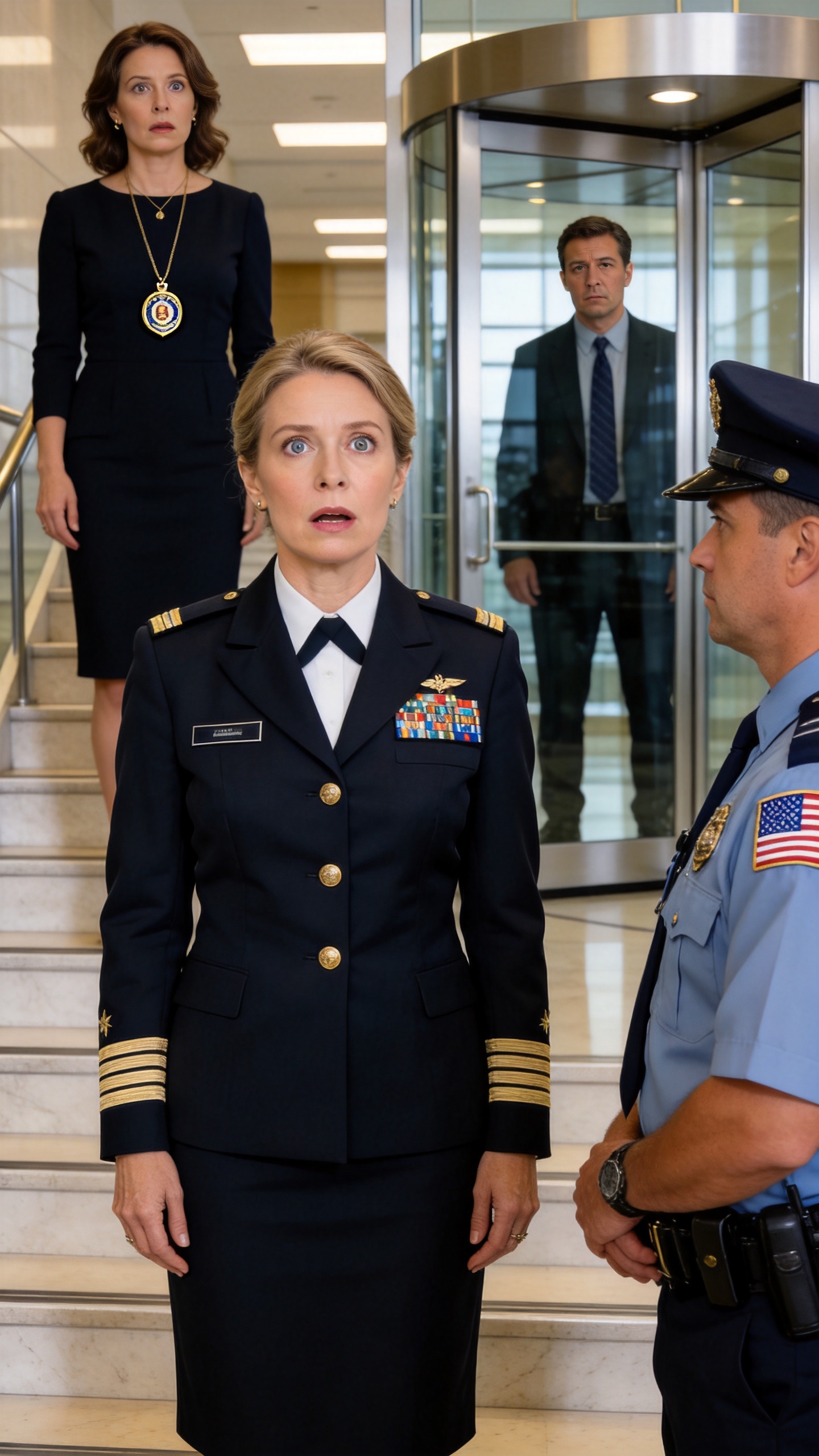
I Drove Three Hours To Surprise My Husband, But The Guard Said, "His Wife Is Upstairs." Then I Saw Another Woman Wearing My Military Pendant
I instructed Caroline not to return her father’s call.
That was the first deception I had ever asked my daughter to share, and I despised myself for it.
She was thirty-one years old, married, raising two young sons in Raleigh, and had spent most of her life learning courage while her mother vanished into one military assignment after another.
Long ago, I had promised myself that once I finally came home for good, I would stop dragging her into problems meant for adults.
But that evening, the problem had already found every one of us.
“Mom,” Caroline said softly, “what is happening?”
I stared at my reflection in the hotel window. My uniform jacket still rested over the chair behind me. The ribbons were perfectly arranged.
The woman reflected in the glass was not.
“I don’t know yet,” I replied. “But I need you to listen carefully. Don’t tell Richard I called. Don’t answer if he keeps pushing.
And if he asks where I am, tell him you don’t know. ”
She stayed silent for a few moments.
“You said Richard,” she finally said. “Not Dad.”
Children always notice the things adults think they are hiding.
“I need time,” I said. “That’s all.”
When the call ended, I reached out to the one person whose judgment I trusted even more than my own: Marlene Pierce, my oldest friend and a retired Army investigator who could size up a situation faster than most people could read a menu.
Marlene lived outside Chattanooga with three dogs, two ruined knees, and absolutely no tolerance for foolish men.
“You’re supposed to be overseas.”
“You sound like you’re standing in the wreckage of something.”
When I finished, she said, “Do not confront him.”
“Good. Men like Richard love controlling the first version of a story. Don’t give him one.”
The following morning, I rented a gray sedan and parked across from Whitlock Freight & Supply. Wearing jeans, sunglasses, and a baseball cap pulled low, I settled in to watch.
For six hours, I observed the building.
At 9:12, Celeste arrived in a white Mercedes.
One of the senior executives carried her coffee.
At noon, Richard emerged with her, wearing the smile of a man who had never betrayed anyone in his life.
As they walked toward a black SUV, he rested his hand lightly against the small of her back. The gesture was intimate, effortless, familiar.
That hurt more than any photograph.
Celeste hosted a luncheon inside the company conference center for spouses of executives.
On the fifth day, Marlene arrived in Nashville.
She stepped into my hotel room carrying a grocery bag filled with coffee, crackers, peanut butter, and two burner phones.
“I’m not asking if you’ve eaten,” she said. “Because I already know you haven’t.”
I nearly burst into tears at the sight of her.
Instead, I asked, “You brought peanut butter?”
“You make terrible decisions when hungry.”
Everything we could legally obtain.
At first the pattern appeared gradually.
Then suddenly it was impossible to ignore.
Celeste Hart had entered Richard’s public world three years earlier as a “brand consultant. ” Six months later, she appeared as a donor liaison for his nonprofit veterans initiative.
One year after that, she stood beside him in photographs from the governor’s economic summit.
By then, news captions were already referring to her as Mrs. Whitlock.
But my mind had already leapt there.
I called my younger sister, Paige.
For a brief second, I felt relief.
Then I heard a male voice in the background ask, “Is that Eleanor?”
“I need to ask you something,” I said. “Do you know a woman named Celeste Hart?”
The silence that followed revealed more than words ever could.
“Ellie, I didn’t know what to do.”
“He said you and he had quietly separated. He said you didn’t want Caroline or anyone else upset while you finished your last deployment. He said Celeste was helping him through it.”
I pressed my palm against the desk.
Men like Richard always knew exactly which emotions worked best.
Paige continued, her voice cracking.
“He made us promise not to bring it up. He said you were fragile.”
I had led soldiers through mortar attacks.
I had written condolence letters.
I had missed half of my daughter’s childhood because I believed service required sacrifice.
And my husband had described me as fragile.
“Did Celeste come to family events?” I asked.
That silence told me everything.
The next blow came from my neighbor, June Halpern, who had lived across from us for two decades. I called pretending I was simply checking in.
“Oh, honey,” June said, “I thought you moved out ages ago.”
My hand went numb around the phone.
“How long has Celeste been staying at my house?”
That night, I drove to the house Richard and I had purchased when Caroline was nine years old.
The rose bushes I planted before my last deployment were blooming beside the walkway.
Through the front window, I could see my dining room chandelier shining above a table prepared for two.
At 8:30, Richard’s SUV rolled into the driveway.
Celeste opened the front door before he reached it.
Then she reached behind his neck and straightened his tie with the easy affection of a wife.
I sat in darkness until my breathing finally steadied.
Marlene nodded toward the house.
“Then let’s find out what else he stole.”
The first attorney I contacted was dead.
He was simply so thoroughly retired that his assistant informed me he was “unavailable to all human conflict.”
The second attorney referred me to Dana Caldwell.
Dana’s office occupied the twenty-third floor of a downtown tower with floor-to-ceiling windows and enough silence to make people confess things they never intended to reveal.
She was a compact woman in her early sixties, with silver hair, red glasses, and the calm confidence of someone who had watched countless wealthy men underestimate countless angry wives.
She listened for forty uninterrupted minutes without touching her coffee.
When I finished, she said, “Colonel Whitlock, your marriage is not my first concern.”
“Your husband has publicly presented another woman as his spouse while you were deployed. He has given her access to your home, your personal belongings, your family, and apparently his company.
That is not merely personal misconduct. It may be connected to financial misconduct, fraud, concealed assets, or improper corporate benefit. ”
Marlene shot me a look that clearly said: I told you.
“We need a forensic accountant.”
He looked like someone who had been born inside a bank statement.
The Guard Used A Title That Belonged To Me
A voice so gentle that even terrible news sounded like a weather report.
Three days later, Harold arrived at Dana’s office carrying five folders.
The moment I saw them, my chest tightened.
For the next two hours, he explained what Richard had spent years hiding beneath the respectable image of Whitlock Freight & Supply.
Consulting payments directed to companies connected to Celeste.
Marketing contracts with no measurable results.
A community outreach fund sending substantial payments to a nonprofit where Celeste served as executive director.
A property management company billing Richard’s business for corporate housing that turned out to be a condominium Celeste used before moving into my house.
“Based on preliminary records,” Harold said, “between four and six million dollars.”
The room seemed to contract around me.
Money had never been the center of my life.
I had served too long to worship it.
Still, that figure hit me hard.
Four to six million dollars was not temptation.
It meant lies carefully stacked on top of lies until they created an entire second life around my husband.
“Did he take from our personal accounts?” I asked.
Over eighteen months, Richard had shifted assets.
Investment accounts had been rebalanced.
Property interests had been transferred.
Certain company shares had been reclassified.
None of it was obvious enough to alarm me while I was overseas, especially since Richard had handled most of our finances for years.
Trust is the quietest form of surrender.
You hand someone the keys to your life and hope they understand how sacred that access is.
“He thought I wouldn’t be home yet,” I said.
“Several transfers are scheduled over the next ninety days. Your early return interrupted something.”
Dana smiled for the first time.
“Oh, we can do more than stop it.”
But the most painful discovery was not financial.
It came two days later from Caroline.
She called me just after midnight, crying so hard I could barely understand her.
“Mom, did you and Dad separate three years ago?”
“Did you tell him you didn’t want me to know?”
“He told me you chose the Army over us.”
Caroline fought to steady her breathing.
“When I got upset that you missed Caleb’s birth, Dad said I needed to stop expecting you to be a normal grandmother. He said you didn’t know how to choose family.”
Something inside me shattered in a place I thought was already broken.
I remembered standing outside a command office after receiving Caroline’s message that labor had started early.
I remembered calling Richard in tears and begging him to tell her I loved her.
I remembered him saying, “She knows.”
Instead, he had used my absence as a weapon.
Someone can steal money and leave a trail.
Someone can steal jewelry and leave photographs.
But when a person steals years of love by poisoning the people closest to you, no ledger in the world is large enough to measure the loss.
The following morning, Caroline drove to Nashville.
When she entered my hotel room, she looked younger than thirty-one.
For a moment, neither of us moved.
Then she crossed the room and collapsed into my arms.
“I thought you didn’t care,” she sobbed.
I held my daughter the way I had when she was small.
As though I could still shield her from every lie in the world.
“I cared every day,” I whispered. “Every single day.”
We cried until there was nothing dignified left in either of us.
Afterward, I showed her everything.
Instead, Caroline became very still.
Then she said, “There’s something you need to know.”
“Dad is hosting an anniversary gala next Friday.”
“Thirty years of Whitlock Freight.”
“He invited investors, board members, local media, the governor’s office, charity donors—everyone.”
Dana, who had arrived for a scheduled meeting, slowly leaned back.
I understood before anyone spoke.
Richard was gathering every person whose trust he had abused into a single room.
And he believed I was still too far away, too uninformed, too fragile to stop him.
“He listed Celeste as co-host.”
“Well,” she said, “that’s generous of him.”
“Colonel, we can file quietly. We can handle this through court.”
I looked at the folder on the table.
Then at the photograph of Celeste wearing my pendant beneath an American flag.
For one full week, I became so calm that it unsettled everyone near me.
Caroline kept asking whether I had slept. Marlene kept putting sandwiches into my hands and watching until I took a bite. Dana kept warning me that exposing everything publicly could create consequences.
Harold kept uncovering fresh documents with the grim steadiness of a funeral director.
But I was not falling apart anymore.
Shock is chaotic. It breaks your thoughts apart. It makes you stare at the same photograph fifteen times, praying your eyes have made a mistake.
On Monday, Dana submitted emergency motions to block certain asset transfers. On Tuesday, Harold finished a preliminary report that traced suspicious company payments to businesses connected with Celeste.
On Wednesday, Marlene reached out to two former Whitlock executives who had left the company abruptly.
Celeste had gained control gradually. First the branding. Then the charity connections. Then executive scheduling. Then vendor approvals. Anyone who questioned how much influence she had was demoted, pushed aside, or offered “generous retirement.”
One former operations director, Tom Braddock, agreed to meet us at a diner outside Franklin.
He was broad-shouldered, with exhausted eyes and grease beneath his fingernails, the kind of man who seemed more at home beside loading docks than inside boardrooms.
“I wondered when you’d come home,” he said.
The words struck me in an odd place.
He looked ashamed. “Not all of it. But enough to know something was wrong.”
Richard had not simply replaced me. He had prepared everyone to doubt me in case I ever came back.
That was the part that turned my grief into ice.
That evening at the hotel, Caroline helped me steam my dress uniform.
My Pendant Was Around Another Woman's Neck
“Are you sure you want to wear this?” she asked.
“Dad might try to make you look dramatic.”
“He spent years telling people I was unstable,” I said. “So I’m going to walk in wearing the one thing that proves exactly who I am.”
Caroline’s eyes filled with tears.
I took her hand. “You believed your father. That is not a sin.”
“No,” I said firmly. “He should’ve told the truth.”
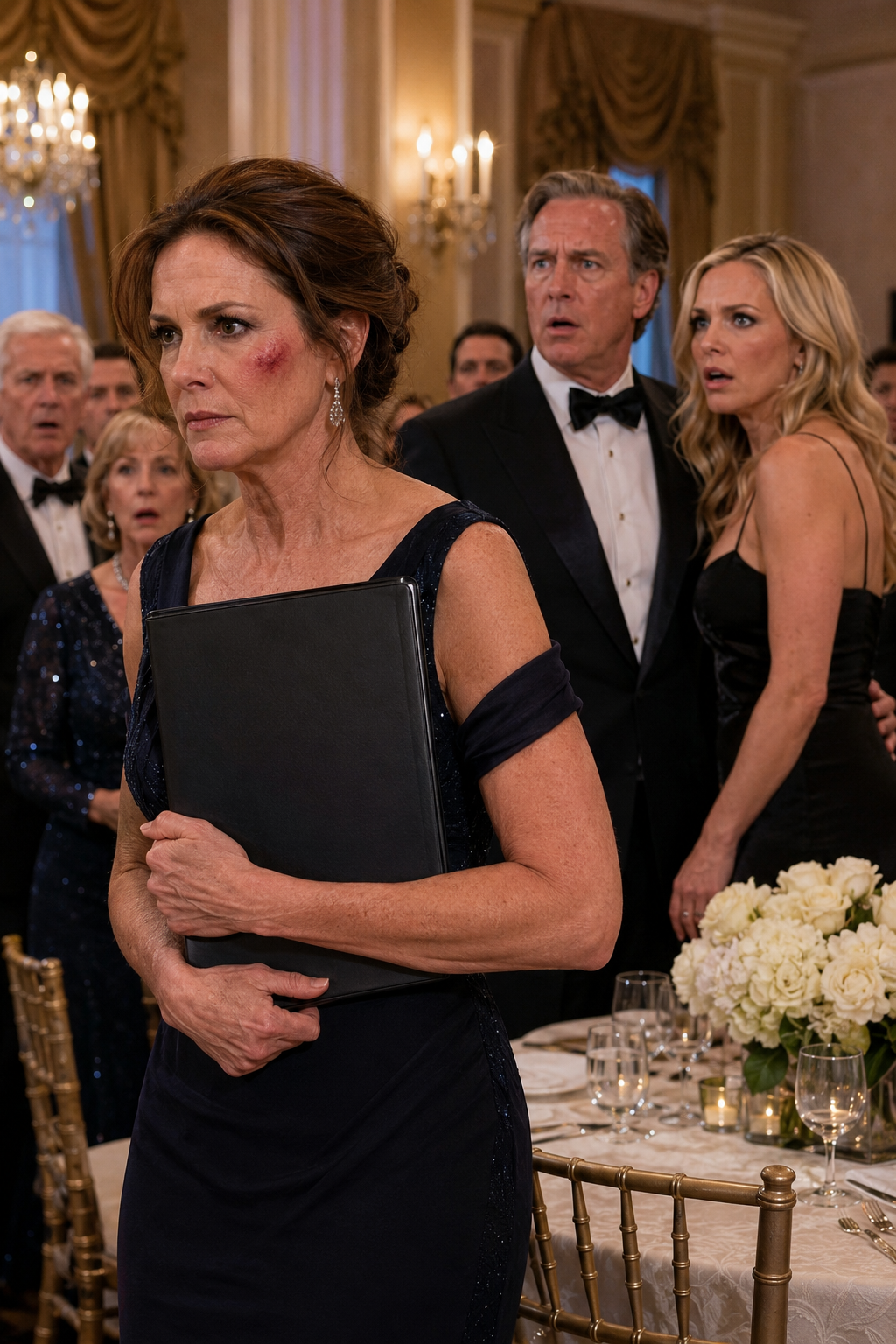
On Friday night, the gala was held at the Bellemont Grand Hotel, a historic Nashville landmark with crystal chandeliers, columns trimmed in gold, and a ballroom that looked built for people who loved hearing their names announced.
More than three hundred guests arrived.
Investors. Board members. Business reporters. Local politicians. Charity directors. Executives. Family friends. People who had smiled at Celeste while pretending my life belonged to her.
I waited in a private hallway with Dana, Marlene, Caroline, and Harold.
Behind the ballroom doors, music played, people laughed, and expensive glasses clinked together.
Dana held a leather portfolio to her chest.
“Last chance to change your mind.”
I looked down at my uniform. Every ribbon sat where it belonged. Every button shone. My hair was pinned cleanly at the back of my head.
“I changed my mind three years too late,” I said. “Not tonight.”
When she pulled away, she whispered, “Make him say it.”
“That you’re my mother. That you’re his wife. That you existed.”
Then the ballroom doors opened.
The uniform caught their attention first. Americans may argue about many things, but a formal military uniform can still shift the air inside a room. Conversations faded. A few older veterans straightened without thinking.
A reporter lifted his camera.
Richard stood near the stage with a champagne flute in his hand. He wore a tuxedo, silver cufflinks, and the confident smile of a man who believed victory was already his.
Celeste stood beside him in a midnight-blue gown.
Around her neck was my silver star pendant.
Behind me, my daughter made a small sound, but I kept walking.
Richard saw me when I was twenty feet away.
I had seen men receive casualty reports with more grace.
Celeste turned first with irritation, then with fear draining the color from her face.
Silence spread through the room in waves.
Someone whispered, “Who is she?”
I stopped at the foot of the stage.
For three seconds, I let Richard look at me.
A photographer lowered his camera.
Celeste’s hand moved to the pendant at her throat.
I turned slightly toward the room.
“My name is Colonel Eleanor Hayes Whitlock,” I said. “I have been married to Richard Whitlock for thirty-one years.”
Then murmurs began. Chairs shifted. Glasses stopped halfway to people’s mouths.
Richard finally found his voice.
“Eleanor, this isn’t the place.”
Her expression hardened, but fear showed clearly in her eyes.
Richard stepped down from the stage.
Caroline stepped to my side, pale but steady.
“No more private lies,” she said.