My Father Blocked Me From My Own Graduation And Said, "You Don't Belong Inside," Until The Dean Called My Name As The Honored Speaker
The ceremony began.
The processional music filled the hall. Graduates moved in long black lines beneath the lights. Families rose with flowers and phones. Names were called. Degrees were conferred. Applause rose and fell in waves.
I stood behind a curtain with my speech folder in both hands.
My advisor touched my elbow.
"Breathe."
I did.
Dean Hart approached the podium after the first awards were given. Her voice carried cleanly through the auditorium.
"Each year, this university recognizes one graduate whose work has already moved beyond academic promise and into public consequence."
My father's head lifted.
On the large screens above the stage, the first slide appeared. It showed a research image from our leukemia trial model, blue and white cells suspended like stars in a dark field.
I heard a small sound from the fourth row.
Lila knew the image. She had once found a printed copy on my desk and used it as a background for a "science girl aesthetic" post before I made her take it down.
Dean Hart continued.
"This year's honoree completed a dual medical and doctoral program while serving in pediatric oncology units, building a clinical data model now under review by multiple national institutions, and securing the largest early-career pediatric research grant this university has ever received."
My father turned toward Marianne.
She was no longer whispering.
"Please welcome Dr. Audrey Collins."
The lights shifted.
My name filled the auditorium.
For one second, everything was sound.
Then I walked onto the stage.
People stood.
Not all at once. First the faculty section. Then the medical graduates. Then the families who understood from the dean's introduction that they were seeing something rare. The applause grew until it seemed to strike the walls and come back harder.
I looked once toward the fourth row.
My father was standing too, but not because he meant to. Everyone around him had risen, and he had been pulled upward by the pressure of public respect he had no control over.
His face had gone pale.
Marianne stared at the screen where my name still glowed.
Lila's phone was angled at the floor, still recording her shoes.
At the podium, I opened my folder.
The first line of my speech waited on the page.
I did not read it.
Instead, I looked out at the room.
"This morning," I said, "someone told me I did not belong inside this building."
The auditorium changed.
Not silence. Something sharper. The intake of thousands of people recognizing that the ceremony had just become a living thing.
I kept my eyes on the back wall.
"I am grateful for that sentence," I continued, "because it reminded me why this work matters. Too many children, too many families, too many patients are treated as if the room was built for someone else. Research is one way of opening the door."
Then I gave the speech I had written.
I spoke about children whose cancers moved faster than standard treatment pathways. I spoke about rural hospitals mailing samples to distant labs and waiting days they did not have. I spoke about data as a moral instrument, about speed, access, and the stubborn belief that a child's zip code should not decide how quickly science reaches them.
I did not mention my father again.
That was the cleanest part of the reversal.
He had made himself small enough to fit inside one sentence.
The work was larger.
When the grant announcement came, Dean Hart returned to the podium with the board chair beside her. A photographer stepped forward. My name was called again. The number was spoken clearly.
Four million dollars.
A dedicated pediatric trial lab.
A university appointment beginning July first.
My father stood abruptly.
I saw it happen from the stage.
He pointed toward me and said something I could not hear over the applause. But the people around him heard. A trustee's wife leaned back. A man in the row behind him frowned. Lila grabbed his sleeve, panicked now that the phone in her lap had turned toward his face.
He pushed past her into the aisle.
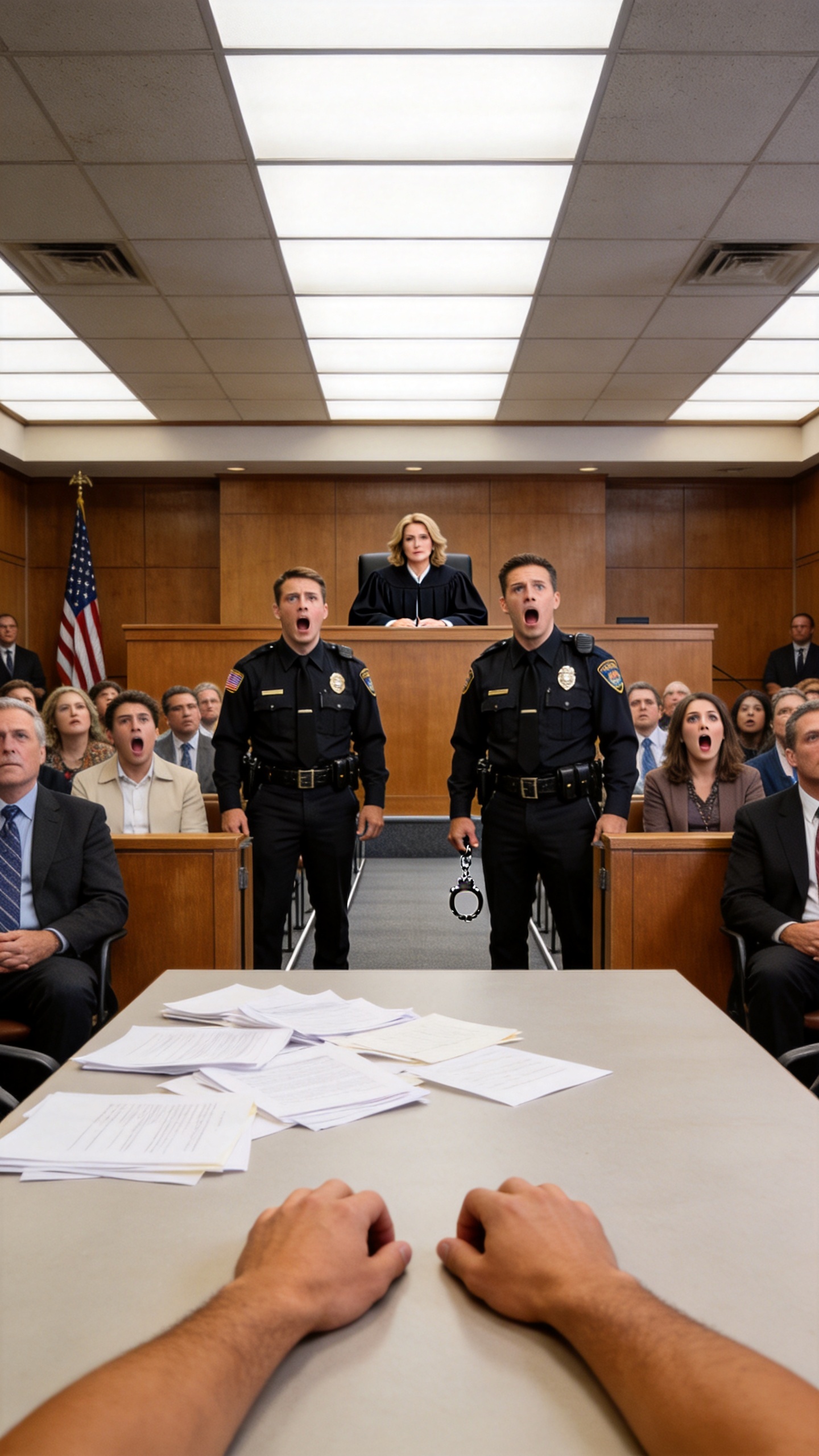
"This is fraud," he shouted.
The applause broke unevenly.
Dean Hart looked toward campus security.
My father kept going.
"She has been living in my house pretending to be broke. She lied to all of us."
The words carried.
They carried far enough for people to turn. Far enough for phones to rise. Far enough for Marianne to close her eyes because she finally understood that public rooms do not always protect the loudest person.
I stood still at the podium.
Security reached him before he made it to the front.
"Sir," one guard said, "you need to step outside."
"I am her father."
The guard did not blink.
"Then you can be proud of her from outside."
A sound moved through the auditorium. Not laughter exactly. Worse for him. Recognition.
My father looked up at me.
For the first time in years, he could not make me move.
So he was moved instead.
Marianne followed with her purse clutched against her ribs. Lila went after them, still holding the stolen ribbon with no credential on it. The aisle seemed longer than it had any right to be. Every step took them past another row of people who now understood enough.
When the doors closed behind them, Dean Hart waited.
Then she turned back to me.
"Dr. Collins," she said gently, "please continue when you are ready."
I looked down at the page.
My hands were steady.
So I continued.
After The Spotlight, The Papers Spoke Too
My father's first message arrived before the reception ended.
Audrey, call me. There has been a misunderstanding.
The second came three minutes later.
You embarrassed this family.
The third came from Marianne.
Your father is devastated. Whatever you think happened, you owe us a private conversation before outsiders get involved.
Outsiders.
That was what she called the university that had protected my funding, the advisor who had written letters for me when I was too exhausted to stand upright, the legal clinic that had helped me read my mother's estate documents correctly.
By noon, Lila's accidental recording had already been shared beyond her own page. It showed my father blocking me outside, the dean calling me Dr. Collins, and later, my father shouting fraud from the aisle. It was messy, humiliating, and badly angled.
It was also clear.
Sponsors who had been flirting with Lila's content account began deleting comments. The hospital executive my father had been courting sent a brief email withdrawing from a proposed consulting arrangement. Two board members who had heard him brag about "guiding his daughter into medicine" asked for clarification that he could not provide.
I did not answer any of them.
At 2:30, I sat in a conference room with Dean Hart, Dr. Ames, the board chair, and a university attorney named Priya Shah.
Priya placed two folders on the table.
One was for the research appointment.
The other was for my mother's house.
"Your father has been representing himself as the sole controlling party," she said. "He is not."
I already knew.
But hearing it said aloud by someone who could act on it changed the room inside me.
My mother's addendum had been simple. Her share of the house was not to be sold, refinanced again, or used as collateral without my written consent after I turned twenty-five. I had turned twenty-five in March. My father had ignored the clause because he assumed I had never seen it.
He had been preparing to evict me from a house he could not legally move against without me.
He had handed my graduation pass to Lila while planning to take my last room.
He had called me useless while using my silence as evidence.
Priya slid a pen toward me.
"We can file the injunction today."
I signed.
The first consequence reached my father that evening at the restaurant where he had taken Marianne and Lila to hide from the internet.
He called me fourteen times.
I answered the fifteenth because Priya was beside me and because I wanted, just once, to hear him speak without a room to perform for.
"What did you do?" he demanded.
I stood by the window of the faculty guest apartment the university had arranged for commencement weekend. Rain moved against the glass in thin silver lines.
"I stopped letting you use my mother's house as a prop."
"Your mother trusted me."
"She wrote down what she trusted."
His breathing changed.
Behind him, I heard Marianne saying my name in a frantic whisper.
"You are being vindictive," he said.
I looked at the doctoral hood folded over the chair. I looked at the grant folder on the desk. I looked at my phone, where my father's name appeared without the word Dad because I had changed it months before and had never changed it back.
"No," I said. "Vindictive would have been telling everyone the truth before you handed my pass to Lila."
He had no answer for that.
The legal process did not fix my childhood. It did not restore the photographs Marianne had boxed, or the birthdays my father forgot, or the years I spent learning to make myself smaller in my mother's own kitchen.
But it did something important.
It stopped the theft from continuing.
Within two weeks, the attempted eviction was withdrawn. Within a month, the refinancing plan collapsed. By summer, my father's business contacts had learned enough to step away from him carefully, politely, permanently. Lila posted one apology video, cried without naming what she had done, and lost the sponsorship she had hoped to secure at my ceremony.
Marianne sent me a long email about forgiveness.
I printed it, put it in a folder with the legal papers, and never replied.
The house took longer.
I went back with a locksmith and two friends from the lab. We found my mother's books in plastic bins in the garage. We found her recipe cards behind a stack of Lila's lighting equipment. We found the blue vase she loved wrapped in newspaper under a broken humidifier.
I kept the house, but I did not move back into the basement.
I turned that room into storage.
Not a studio.
Not a punishment.
Just storage.
Some spaces do not need to become symbols. Some only need to stop being wounds.
One year later, the Collins Pediatric Data Lab opened on the east side of campus.
The reception area was small, bright, and always too cold because the equipment rooms ran warm. My mother's photograph sat on the shelf behind my desk in a silver frame. Below it, in a drawer, I kept the first program from commencement day.
Not because I needed proof.
Because I liked the order of the printed names.
Mine where it belonged.
The work where it belonged.
The people who had tried to block the door nowhere on the page.
On the first Friday after the lab opened, the receptionist called my office.
"Dr. Collins," she said carefully, "there is a man here asking for you. He says he is your father."
I looked through the glass wall.
Grant Collins stood in the lobby wearing an old overcoat I had never seen him wear before. He looked thinner. Less polished. His phone was clutched in both hands.
For a moment, I felt the old pull.
The daughter reflex.
The one that asks whether pain becomes smaller if you comfort the person who caused it.
Then I opened the door.
He stood when he saw me.
"Audrey," he said.
Not Doctor. Not sweetheart. Not my quiet one.
Audrey.
"I need an introduction," he said. "Just a meeting. The board chair still respects you. If you explain that the ceremony got out of hand..."
I waited.
He looked past me into the lab, at the students moving between benches, at the equipment humming behind glass, at my name printed on the wall.
His face changed.
There it was again. Not pride.
Calculation.
I stepped into the lobby and let the door close behind me.
"You told me I did not belong inside," I said.
His eyes flickered.
"I was upset."
"No," I said. "You were certain."
He swallowed.
"Audrey, I am still your father."
I thought of the bronze doors. The rain. Lila wearing my pass. Marianne saying one good day as if my life had been a courtesy she could redistribute.
"You are the man who tried to keep me outside the room where my name was being called," I said. "That is enough truth for both of us."
He stared at me for a long time.
Then his shoulders dropped.
Not in apology.
In defeat.
I did not ask security to remove him. I did not need the drama. I simply turned, opened the glass door, and walked back into the lab.
This time, he did not follow.
At my desk, I picked up the silver frame and wiped a speck of dust from the corner of my mother's photograph.
"We kept the house," I told her softly.
Then I looked through the glass at the students bent over their work, at the monitors glowing, at the grant calendar filling with impossible deadlines and possible futures.
Outside, campus bells began to ring the hour.
Somewhere in the city, my father was still learning what public shame felt like when no one could be ordered to look away.
I sat down, opened the trial data, and returned to the work that had carried me farther than his permission ever could.