I Gave Up Everything To Raise My Late Fiancee's 6 Children. Ten Years Later, Her Oldest Son Came Home And Said, "Dad, I Think You Deserve To Know The Truth About Mom"
When my fiancee vanished, everyone assumed I would hand her six children to relatives and go back to the life I had before her.
I did not.
I stayed.
For ten years, I packed lunches, signed permission slips, learned which child hated peas and which one needed the hallway light left on, and answered to Dad long before any court document said I had the right.
Then her oldest son came home one Friday night, stood in my kitchen doorway, and said something about his mother that made the floor feel like water beneath my feet.
"Dad," he said, "I think you deserve to know the truth about Mom."
But before that sentence, there was a beach.
There was sun.
There was a paper bag of fries going soft in my hand.
There was Maya laughing at me because I had managed to carry three lemonades, two sodas, a bucket of shells, and still drop the napkins into the sand.
She was thirty-four, a widow, a mother of six, and the bravest woman I had ever known.
I was twenty-eight and foolish enough to believe love could be proven by promises.
Maya taught me it was proven by showing up after the pretty words were gone.
That day, the line at the pier stand had stretched halfway down the boardwalk. The younger kids were digging a moat around a sandcastle. The twins were arguing over a plastic shovel. Her oldest, Caleb, stood near the water with his arms folded, pretending not to like me.
Maya kissed my cheek.
"Go before it gets worse," she said. "I'll keep them alive for twelve minutes."
Those were the last ordinary words she ever said to me.
The Beach Kept Her Towel And Gave Us Nothing Else
I was gone maybe fifteen minutes.
When I came back, the children were still in the sand.
The towel was still there.
Maya's sunglasses were folded on top of her book.
Her sandals sat side by side near the cooler.
But Maya was gone.
At first, I thought she had stepped into the water.
I shaded my eyes and searched the waves for her dark hair, waiting for her to come up laughing because she had scared me.
Then I saw Caleb at the shoreline.
He was twelve then, all elbows and anger, with a face too old for his body.
"Where's your mom?" I asked.
He did not answer.
He stared at the ocean like it had spoken to him in a language he hated.
By sunset, half the beach was searching.
By midnight, police lights flashed against the dunes.
By the fourth day, the official words had begun to sound rehearsed.
Possible drowning.
No evidence of foul play.
No body recovered.
The memorial happened with an empty urn and six children sitting in the front pew.
The youngest, Emmy, was two. She kept asking when Mommy would come back from the water.
Maya's aunt told me I had done enough.
My own brother told me I was young enough to start over.
A social worker used the phrase "temporary placement" and looked at the children as if they were a problem waiting for paperwork.
I looked at Caleb.
He looked back at me with a challenge in his eyes.
You will leave too.
I heard it as clearly as if he had said it.
So I did not leave.
I sold my motorcycle first.
Then my tools.
Then the little fishing boat my father had left me, because six children needed shoes more than I needed memories with an engine.
I took night shifts at the warehouse and morning work repairing roofs.
I burned pancakes.
I ruined laundry.
I learned that little girls can cry over the wrong socks with the same grief grown men reserve for funerals.
I learned that grief does not move out of a house just because rent is due.
It sits at the breakfast table.
It rides in the minivan.
It hides in the school projects where every child has to draw a family tree.
For the first year, Caleb hated me with discipline.
He missed curfew.
He picked fights.
He called me Ben when the others started calling me Dad.
I let him.
Love that needs a title too quickly is usually trying to collect a debt.
I was not there to collect.
I was there because Maya's children deserved one adult who did not turn pain into an exit sign.
Ten Years Can Make A Family And Still Leave One Door Locked
The first time Caleb called me Dad, he was sixteen.
It was raining.
The twins had missed the bus, Emmy had a fever, and I was standing in the kitchen wearing one boot and holding a lunch box full of something I hoped was turkey.
Caleb came down the stairs, grabbed his backpack, and said, "Dad, the sink is leaking again."
Then he froze.
I froze too.
We both looked at the sink as if plumbing had become sacred.
"I'll fix it after work," I said.
He nodded.
Neither of us mentioned it.
After that, the word came and went like a shy animal.
By the time he left for college, he used it without flinching.
I did not adopt the kids all at once. Courts are not built for feelings that complicated.
There were hearings, background checks, letters from teachers, testimony from neighbors, a cousin who appeared briefly to ask whether there was insurance money and disappeared when there was not.
Eventually, the younger four carried my last name by choice.
The older two did not.
I told them both the same thing.
"A name is not rent. You don't owe me yours."
Maya stayed in the house in other ways.
Her recipe cards remained in a tin above the stove.
Her red sweater hung at the back of my closet because Emmy liked to hold the sleeve when nightmares came.
Her laugh appeared sometimes in the twins at the exact moment they were trying not to be kind.
For ten years, I built a life around a missing space.
Then Caleb came home early from a weekend trip.
He did not text first.
He did not bring laundry.
That was how I knew something was wrong.
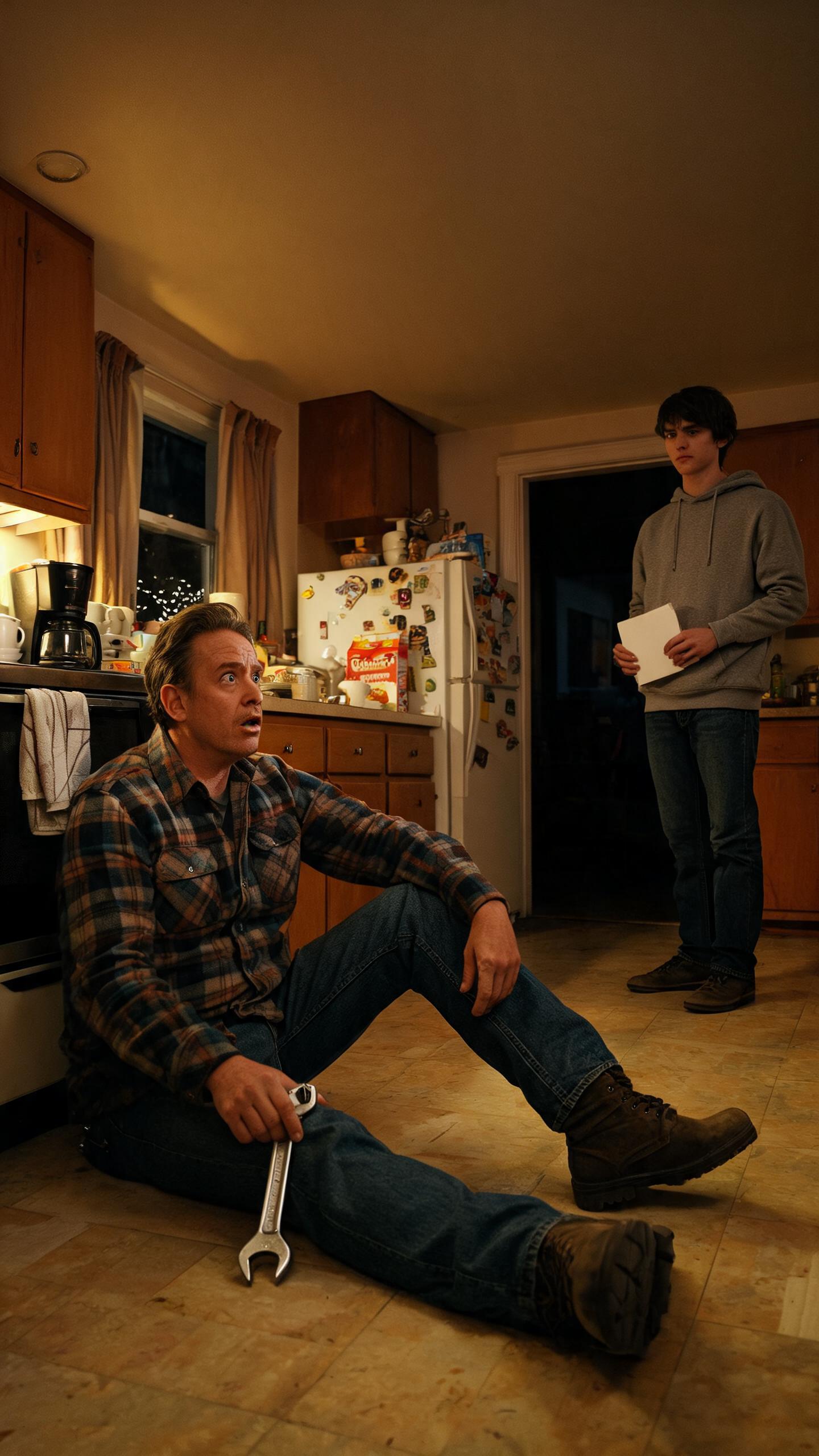
I was on the kitchen floor fixing the cabinet hinge when he walked in. He was twenty-two, taller than me now, with Maya's eyes and his own careful silence.
"Caleb?"
He stood in the doorway with his duffel bag still on his shoulder.
"Dad, I think you deserve to know the truth about Mom."
The screwdriver slipped from my hand.
He Saw Her In A Town We Had Never Visited
He had gone to a coastal town called Harbor Glen with three friends.
Small place.
Tourist shops.
Old boardwalk.
Bad parking.
He was walking past a bakery when he saw a woman arranging flowers in the window of a little inn across the street.
At first, he thought grief was playing a trick.
Grief does that.
It puts a lost face on strangers in grocery stores.
It makes you hear a voice in a crowded room and turn too fast.
But then the woman lifted her left hand to tuck hair behind her ear.
There was a crescent-shaped scar at her wrist.
Maya had gotten that scar opening a can of peaches during a storm outage, laughing while blood ran down her arm because the kids were screaming and I had gone pale.
Caleb crossed the street.
The woman saw him through the glass.
He said she dropped the flowers.
"Did you speak to her?" I asked.
He nodded.