That Morning, My Son Texted, "Plans Changed. You're Not Coming on the Cruise. My Wife Wants Only Her Family." I Didn't Argue. The Next Day, I Canceled Every Payment
I held her hands and told her no.
She had asked the question while sitting on my condo floor, knees tucked under her, a plastic whale in one hand. Children do not understand filings and trustees, but they understand when love starts sounding conditional.
I wished every adult in the room had understood the question behind hers: will the people I love still come back?
After the ruling, Andrew visited less. Lauren stopped sending photos unless she needed something. I told myself distance was better than fighting in front of Bella, but loneliness can make a person vulnerable to any gesture that looks like peace.
The Cruise Invitation Was Never Really an Invitation
A year later, Lauren suggested a family cruise as a fresh start.
She wanted Bella to have a happy memory after the legal fight. Andrew sounded hopeful. I wanted to believe them.
I should have asked more questions. Instead, I listened to the word "family" and let it do what it had always done to me. It softened the edges.
It made me imagine dinners where nobody mentioned court, mornings where Bella tugged my hand toward the pool, photographs Robert would have loved.
I paid for the trip because Andrew said money was tight after business repairs and legal fees. I booked two cabins, shore excursions, flights, transfers, and insurance.
I chose a refundable package because teachers learn to read the margins. I told myself it was sensible travel planning, not suspicion. Still, I kept every confirmation email in a folder and paid from my own account, with my name clearly attached to each reservation.
Lauren sent me links for outfits and luggage tags. She asked whether I could also cover Bella's summer music program before we left.
I said yes to the music program because Bella had asked for it herself.
That distinction mattered to me. Bella wanted music because she had heard a cellist at the library and spent the drive home humming. Lauren wanted the cruise to look a certain way. I could still say yes to the child while learning to say no to the performance.
Two weeks before departure, Lauren stopped mentioning my cabin in group messages. One week before departure, Andrew called twice and hung up before I answered.
I watched the pattern form. Photos of swimsuits for Bella. Questions about dinner packages. Nothing about my boarding documents, my passport, my medication schedule, or whether I wanted the balcony room I had paid extra to reserve.
Then, on the morning before the final payment deadline, he sent the text.
"Plans changed. You're not coming on the cruise. My wife wants only her family."
Only her family.
I looked at Robert's fountain pen on my desk, the one he had used to sign our first mortgage. I thought about the house. The trust. The court. The years of being treated as useful until I became inconvenient.
The pen was black with a narrow gold band, worn smooth where Robert's thumb had rested. He believed signatures meant something.
He had signed checks for school fees, mortgage papers, birthday cards, apology notes. He would have been heartbroken by Andrew's message, but he would also have understood the arithmetic of it.
I did not argue.
Arguing would have let them make the issue my tone. Silence forced the facts to stand alone.
What I Canceled
The cruise line allowed cancellation because the insurance deadline had not passed. The refunds returned to the account from which I had paid.
The agent on the phone sounded relieved when she realized my name was the primary payer. She asked twice whether I wanted to cancel the entire booking. I looked at Andrew's text again and said yes, the entire booking.
The shore excursions vanished first. Then the private transfers. Then the cabin upgrades Lauren had chosen without asking.
There was a strange calm in watching the confirmations arrive. Snorkeling excursion canceled. Specialty dining canceled. Airport car canceled. Balcony upgrade canceled. Each email was a small hinge closing.
I called Bella's music school and changed the billing so future approved lessons would go through Martin, not through Lauren.
I contacted the private tutor Lauren had added to my card and removed my authorization.
That charge had bothered me for weeks. Lauren had called it "extra support," but the tutor had never spoken to Martin, and Bella had never mentioned needing help. It was exactly the sort of blurred expense the trust had been built to prevent.
Finally, I wrote Andrew one email.
"Since I am not family for the purpose of this trip, I will no longer fund family expenses outside Bella's trust-approved needs. I love you. I love Bella. I am done being treated as a wallet with a chair at the edge of the room."
He called eighteen times.
I let every call go to voicemail. The messages began angry, turned pleading, and finally became confused. "Mom, call me back." "We can fix this." "Bella is going to be crushed." Not once did he say, "I am sorry I uninvited you from something you paid for."
Lauren texted that I was punishing a child. I answered once: "Bella's education remains protected. Your vacation does not."
Then I blocked Lauren for the night, made tea I did not drink, and sat at Robert's old desk until the room went blue with evening.
The Truth Came Out in the Driveway
Andrew arrived that evening, pale with anger.
"Do you know what you did?" he asked.
"Yes."
"Bella has been talking about this cruise for months."
"Then explain why her grandmother disappeared from it overnight."
He opened his mouth and closed it again. The porch light made him look younger, almost like the boy who used to stand in that same defeated posture when he had broken something and hoped I would not ask how.
He rubbed both hands over his face. "Lauren thought it would be less tense."
"Lauren thought I would pay and stay home."
He did not deny it.
For years, Andrew had treated Lauren's decisions as weather. Unpleasant, unavoidable, nothing anyone could control. But this decision had required his phone, his thumbs, his willingness to press send.
That silence was different from the one in the closing office. This time, he understood what it admitted.
"I kept hoping everything would calm down," he said.
"You have not been calming anything," I told him. "You have been available for signatures."
He flinched. I did not soften it. A parent spends decades cushioning a child from hard landings, but there comes a point when cushioning becomes permission.
The words hit him hard because they were true.
Andrew had signed the trust. Signed the petition. Approved the cruise change. Let Lauren make decisions, then acted surprised when consequences arrived.
I told him I loved him enough to stop pretending helplessness was kindness. If he wanted a relationship with me, it had to include honesty before the damage, not regret afterward.
For the first time in years, my son looked less angry than ashamed.
When he left, he did not slam the door. He stood beside his truck for a long time before driving away.
Bella's Center Tower
The cruise did not happen. Andrew could not afford to replace what I had canceled, and Lauren refused to take a smaller trip.
For several months, we barely spoke.
Bella sent me drawings through Andrew sometimes. A blue fish. A boat with five circles for portholes. A stick figure with gray hair standing beside a smaller figure with yellow curls.
I kept every one on my refrigerator, but I did not use them as an excuse to reopen the wallet Lauren had tried to control.
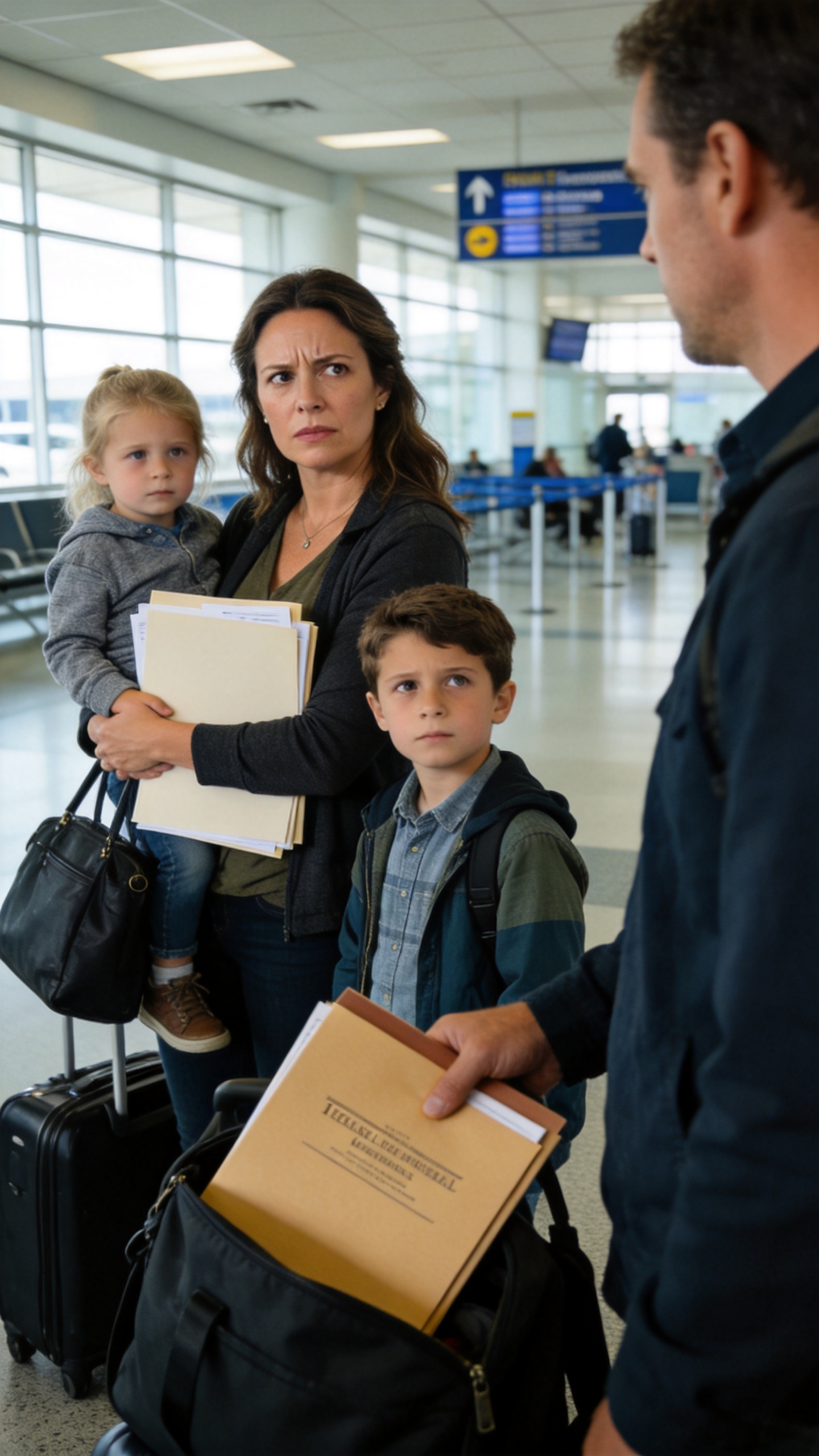
Then Lauren made a frightened, reckless choice that changed everything. Convinced everyone was controlling Bella's future, she tried to leave the state with her.
Andrew called me at dawn with a voice I had never heard from him before. Not angry. Not defensive. Terrified. Lauren had packed Bella's clothes, taken her tablet, and left a note saying she needed space from people who wanted to steal her child's life.
Authorities found them in Arizona two days later. Bella was safe but terrified. Lauren insisted she had only been protecting her daughter.
No one celebrated being right. There is no satisfaction in watching fear become a suitcase. Lauren had crossed a line, but she was also unraveling, and Bella had been the one strapped into the back seat while adults called panic love.
Family court gave Andrew temporary primary custody. Lauren received supervised parenting time, counseling, and a co-parenting program.
The trust stayed untouched. Future travel required written agreement or court approval.
Andrew finally began to read every document before signing it. He met with Martin without Lauren beside him. He asked questions about Bella's needs instead of asking how to access funds.
Slowly, painfully, he became less available for signatures and more available for his daughter.
Healing took longer than any order.
Lauren's supervised visits were awkward at first. Bella clung to Andrew's sleeve. Lauren cried too easily. I stayed back unless invited, because part of protecting Bella meant not turning her mother's failure into a stage for my victory.
One spring afternoon, after months of counseling, we all met at a small lakeside beach. Bella built a sandcastle with four towers: one for me, one for Andrew, one for Lauren, and one tiny tower in the middle.
"That one is mine," she said proudly.
Andrew asked why hers was in the center.
"So everybody knows where to find me."
No adult answered. We had spent years fighting over who knew best, while Bella only wanted to know where she belonged.
Lauren covered her mouth. Andrew looked out at the water. I pressed my palms into the sand so I would not reach for Bella and make the moment about my comfort.
That tiny center tower said what no court order could: the child was not a prize, a project, or proof. She was the person all our choices had been circling.
What the Old House Protected
Years passed. The trust grew.
Bella discovered marine biology, exactly as her childhood ocean books had hinted. At fourteen, a small trust-approved distribution sent her to a summer science program she chose herself.
The request came in Bella's own words. She wrote Martin a letter explaining why she wanted to study coastal ecosystems, how much the program cost, and what part Andrew could cover. It was careful, hopeful, and entirely hers. Martin approved it within the week.
At eighteen, she sat across from Martin and stared at the account summary.
"All this came from Grandma's house?" she asked.
"Yes," Martin said.
The office was quieter than the closing room had been years earlier. Same sort of table, same neat stack of papers, but this time no one was demanding access. Bella read slowly, tracing the numbers with one finger as if they might disappear.
She turned to Andrew. "Did you want this money?"
He smiled sadly. "Very much."
"Are you still upset Grandma did not give it to you?"
"I was," he admitted. "Then I learned that wanting access to something does not make it mine."
That sentence was worth more to me than any apology. It meant he had finally separated need from entitlement, love from control, and family from funding.
Lauren cried when Bella asked whether her childhood had been bad.
"No," Lauren said. "I just believed ordinary would never be enough."
She had done years of counseling by then. She and Andrew were no longer married, but they could sit in the same room for Bella without turning every sentence into a contest. Lauren's answer was not perfect, but it was honest.
Bella squeezed my hand and chose marine science.
Not because I had planted the idea. Not because Andrew approved it. Not because Lauren could put it in a holiday newsletter. She chose it because the ocean had been calling to her since she was small enough to fall asleep holding a plastic whale.
On the morning she left for college, I gave her Robert's fountain pen.
"He signed our first mortgage with this," I said. "I used it for the trust."
Bella held it like a key.
"Then I will use it for my future."
For a second I saw every version of the house at once: Robert signing the mortgage, Andrew running down the stairs late for school, Bella reading ocean books on my rug.
I saw myself standing in the kitchen with that cruel text glowing in my hand. The money had never been the point. The point was giving one child a door that stayed open.
Before she got into the car, she asked for advice. After a lifetime of teaching, only one sentence mattered.
"Never confuse someone loving you with someone owning your choices."
The redbrick house belongs to another family now. Its shutters have changed color. Children play where Andrew once waited for the school bus.
I still miss it. I do not regret selling it.
My house became a trust. The trust became opportunity. Opportunity became Bella's future.
And the morning my son told me I was not family enough for a cruise, I finally stopped paying for a place where love came with conditions.