
My Mother-In-Law Shaved My Daughter Bald For "Humility," But In Court My Husband Was Asked One Question And Finally Showed The Judge Who He Protected
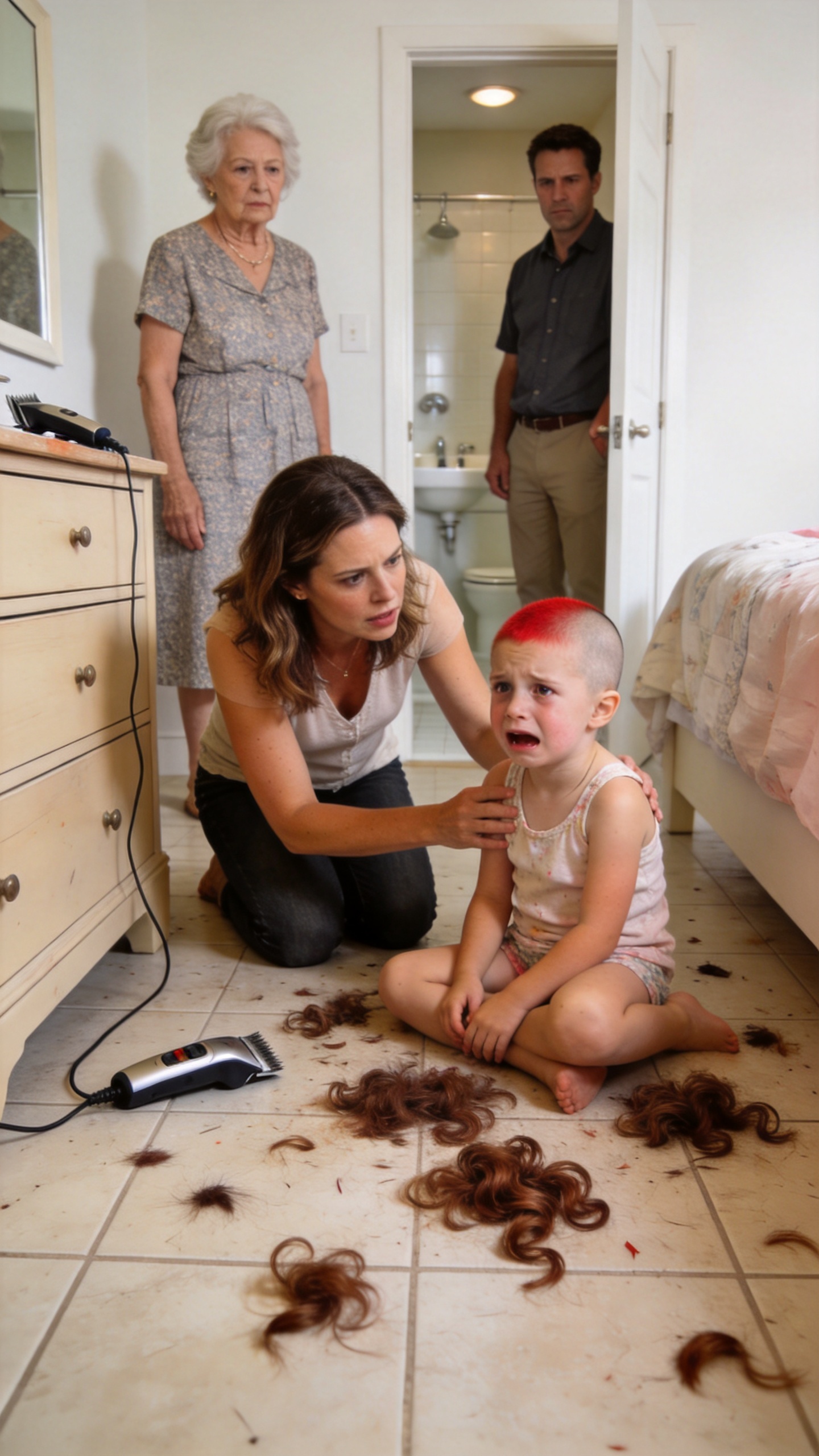
Olivia found the hair before she found Mia.
Brown curls covered the bathroom tile.
Not a trim.
Not a mistake.
Piles of hair, thick enough to make the room look robbed.
The clippers sat on the dresser.
Mia sat under the window with both hands over her head.
Her scalp was red in two places.
Carol stood beside the bed with the calm face of a woman waiting to be praised for discipline.
"Pretty girls become proud girls," she said.
Nate arrived seven minutes later.
He looked at his mother first.
Then at Olivia.
Then at the floor.
He still did not look at Mia.
The Hair On The Tile Was Not A Trim
Olivia said one word.
"Hospital."
Carol sighed as if Olivia had spilled soup.
"It is hair."
Mia flinched at the sound of her grandmother's voice.
That flinch ended the argument for Olivia.
Nate tried to stand in the doorway.
"Let's not make this bigger."
Olivia picked Mia up.
Mia's fingers grabbed the back of her shirt and held on.
That was the size of it.
Not the hair.
Not the clippers.
The hold.
A child holding on because the adults in her house had started negotiating whether her fear was inconvenient.
He Wanted Softer Words For An Ugly Reality
At urgent care, Nate wanted different language.
Not abuse.
Not assault.
Not trauma.
"Mom thought she was helping," he said.
The nurse was taking photos of Mia's scalp.
Mia stared at the wall.
Olivia heard every word Nate did not say.
He did not say Mia was hurt.
He did not say his mother was wrong.
He did not say it would never happen again.
He only kept sanding down the truth until Carol could hold it without shame.
Olivia signed the intake form.
Then she called an attorney from the parking lot.
Every Report Said The Same Thing
The reports did not use Carol's favorite words.
They did not say old-school.
They did not say strict.
They did not say family matter.
The pediatric note said visible distress.
The school counselor wrote fear response.
The therapist wrote violation of bodily autonomy.
The old texts showed Carol warning that Mia's curls made her vain.
In court, Nate looked smaller than Olivia expected.
Then the judge asked one question.
"If this happens again, who will you protect first?"
Nate opened his mouth.
Closed it.
Looked at his mother.
And answered before he meant to.
The Judge Made Him Choose Out Loud
That hesitation rearranged the case. It showed the judge that the danger was not only Carol’s cruelty, but Nate’s lifelong habit of making room for it.
There were messages afterward. Some were apologies with no ownership inside them. Some were orders wearing the costume of concern.
Some came from people who had watched the whole thing and now wanted credit for privately disagreeing.
Olivia answered fewer than expected.
She had learned something that day: the people who demand immediate forgiveness often waited a very long time before offering basic protection.
Olivia knew Mia’s hair would grow back. The harder work was teaching her daughter that nobody who loved her was allowed to call fear humility.
That lesson began with small choices: no forced photos, no cheerful cover story for relatives, no pretending the hood was a phase when it was a shield.
Carol tried to give the first clean explanation before anyone else could ask an honest question.
That was how the old pattern survived: not by proving itself, but by speaking first.
In the bedroom and courtroom, the clean version made Olivia sound sensitive, confused, jealous, dramatic, or ungrateful, while everyone else got to sound reasonable.
The insult was never only the sentence. It was the speed with which people reached for a version that protected the person who had caused it.
Olivia could trace the pattern backward without effort.
There had been smaller scenes, quieter humiliations, little tests of how much he would absorb before asking to be treated as real.
the therapy notes mattered because it proved the past had not been imaginary. It gave shape to the things people had called mood, tension, or misunderstanding.
When a pattern finally has a record, the people who benefited from forgetting it suddenly become very interested in forgiveness.
Mia did not arrive like a rescuer in a movie. The witness mattered because the room could no longer keep the story sealed inside the family performance.
Before that, Carol and Nate could act as if their version was the only version available. After Mia became part of the moment, the air changed.
People were not kinder yet, but they were less certain, and that was the first crack in the old control.
the clippers looked ordinary until everyone understood what it carried. That was the power of a concrete object. It does not argue. It does not beg.
It sits in the room making vague excuses harder to sell.
Once Judge Helena Price was connected to the object in front of them, the old language started failing.
There was no elegant way to make the harm sound harmless anymore.
The reversal did not make Olivia feel triumphant in the simple way people imagine. Mostly, he felt tired.
Being proven right after years of being minimized is not the same as being healed.
It is a relief, yes, but it also forces a person to look at how long the obvious had been denied.
In the bedroom and courtroom, the silence after the truth landed felt less like justice than like a bill finally being placed on the correct table.
The messages afterward revealed who had learned nothing. Some people wanted Olivia to calm down now that the truth was public.
Some wanted her to protect Carol from embarrassment. Some wanted a private conversation because private rooms had always been easier places to pressure him.
She read those messages slowly and noticed how many began with concern but ended with instructions.
Olivia's boundary did not look dramatic. It looked like delayed replies, written confirmations, fewer favors, and no more conversations designed to make her doubt her own memory.
People who had mistaken access for love found that change cold. She let them think so.
Warmth had been demanded from her for years by people who offered performance in return.
Mia's unused hood became the detail she remembered after the noise faded. Not because it solved everything, but because it belonged to her.
The old story had required her to keep adjusting herself around everyone else's comfort. This new detail did not ask her to adjust.
It simply waited, steady and quiet, proof that a life can continue after a room finally sees the truth.
What hurt most was not that Carol had lied or minimized. It was how many people had been willing to treat the lie as manners.
They called it keeping peace when Olivia was the only one paying for that peace.
They called it timing when the timing was always bad for the person who needed protection.
Once the therapy notes surfaced, those polite words began to look less like etiquette and more like cooperation.
By the time the school hallway entered the story, the room had already changed sides more than once. Some changed out of conscience. Some changed out of self-preservation.
Olivia no longer needed to sort every motive.
She only needed to notice which people required proof before offering decency, because that told her exactly how much trust they deserved afterward.
Olivia refused to let anyone rename the harm as a scene she had caused. The scene had been there before she answered.
It had been in the looks, the omissions, the jokes, the doors, the paperwork, the silence. Her response only made the existing thing visible.
That distinction mattered, because people who create harm often want the exposure to stand trial instead of the act itself.
The practical decisions came before peace. Names, calls, doors, accounts, invitations, records, and expectations all had to be changed one at a time.
Olivia did not float away from the room into instant calm. She built calm like a fence, post by post.
Each small decision said the same thing: the old access would not return simply because the old people missed it.
A later apology arrived with careful wording. It sounded better than the first excuses, but Olivia had learned to listen for ownership instead of music.
The apology named discomfort more easily than harm. It named embarrassment more easily than responsibility. She did not argue with it.
She put it beside everything else she now understood and let it remain incomplete.
In the end, the biggest change was maintenance. Olivia stopped maintaining the version of the story that made Carol and Nate look softer.
She stopped adding context to cruelty so other people could digest it. She stopped offering cheerful explanations for why she had survived what they preferred not to name.
That refusal became the real ending.
Other memories came back after the main room quieted.
Olivia remembered the small corrections, the jokes that needed her laugh to look harmless, the favors that were treated as duty, and the warnings she had talked herself out of believing.
None of those memories would have won an argument alone. Together, they made a map.
The bedroom and the courtroom only made the map readable to other people.
Nate's silence deserved its own name. It was not confusion, and it was not helplessness. It had protected the easier person for too long.
Olivia had once treated that silence as weakness because weakness was easier to forgive. After the therapy notes, she understood it as a choice.
That understanding hurt, but it also cleaned the air. You cannot build a boundary around someone until you stop pretending they never meant to stand where they stood.
The apology that arrived later tried to begin at the ending.
It wanted to discuss how everyone could move forward without spending too much time on how everyone had arrived there. Olivia refused that shortcut.
Moving forward did not mean stepping over the pattern.
It meant naming every place the pattern had been allowed to settle, especially the polite places that had made the harm look respectable.
Practical records became strangely comforting. Dates, messages, receipts, photos, logs, lists, account notes, or witness names gave Olivia something steadier than emotion to hold.
She did not need those records because her memory was weak. She needed them because other people had spent years acting as if her memory was negotiable.
A record can be cold, but sometimes cold is exactly what a room full of performance cannot melt.
People began asking the wrong questions almost immediately. Why had she waited? Why had she not said it sooner? Why did it have to happen here?
Olivia heard the hidden accusation inside each question. They were not really asking about timing. They were asking why she had stopped protecting the people who embarrassed her.