At My Son's Wedding, My Wife Came Home Shaking and Said She Had Only Fallen
The silence that followed was not surprise. It was calculation.
"You recorded me?" Cassandra asked.
"The venue did."
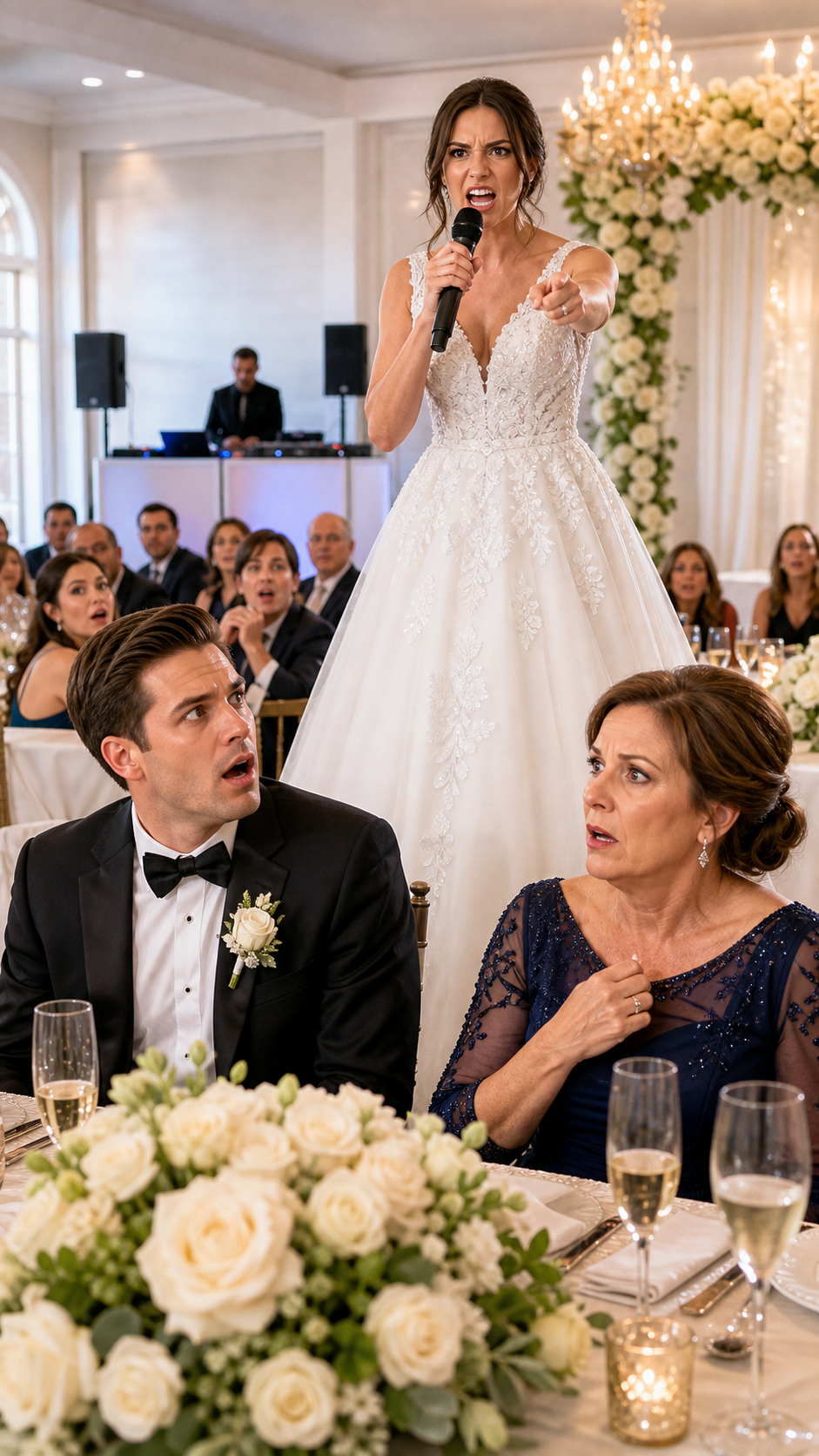
Cassandra gave a soft laugh. "You really want to start your relationship with your daughter-in-law like this?"
Ellen's voice did not grow louder. It became clearer.
"I do not have a daughter-in-law."
Then she ended the call.
Ellen placed the phone facedown on the table and stared at it as though it might bite.
"She will tell people I threatened her," she said.
"Probably."
"She will tell Michael I am trying to destroy his marriage."
"Probably."
Ellen rubbed the bruise on her arm, then caught herself and put both hands flat on her lap. "I hate that I am scared of a girl half my age."
"You are not scared of her," I said. "You are scared of what Michael will excuse."
That was the truest sentence I had said all week, and it cost both of us something.
Within an hour, Cassandra texted Ellen three times. The first message was polished and threatening. The second was sentimental. The third said family problems should stay private unless Ellen wanted everyone to know how unstable she had been at the wedding.
Ellen read the last one, then handed me the phone.
"Send them to Margaret," she said.
It was the first time since the wedding that her voice did not ask permission.
The Locks Were Already Changed
That evening, Michael came to our house without knocking. He still had a key, or believed he did. The lock turned, stopped, and rattled.
I had changed it that morning.
He pounded on the door until I opened it. I did not step aside.
"You changed the locks?" he demanded.
"On anyone who does not live here," I said.
He looked past me. "Where is Mom?"
"Speak from here."
Ellen appeared behind me. For the first time, Michael seemed to notice the bruises.
"Mom," he said softly. "I did not mean for you to get hurt."
Ellen answered, "You hurt me."
He blamed stress. Cassandra crying. Her mother being upset about the seating. The pressure of wanting one perfect day.
"And I was the thing wrong with it?" Ellen asked.
He looked away. That was his answer.
Ellen stepped forward. "At your wedding, I brought you your grandfather's cufflinks. You brought me bruises."
Michael covered his face. "Mom, please."
"No," she said. "You do not get to ask for comfort before accountability."
Michael looked at me then, expecting the old pattern. I would step in. I would translate Ellen's pain into something easier. I would say everyone needed time, or weddings were stressful, or we all loved one another and should lower our voices.
I stayed quiet.
His face changed when he realized I was not coming to rescue him from the woman he had hurt.
"Dad," he said. "Say something."
"Your mother is speaking."
That was all.
Cassandra's car idled at the curb with its headlights on. I could see her silhouette through the windshield, one hand lifted as she spoke into her phone. Even from the porch, she looked annoyed that accountability was taking longer than expected.
Michael followed my glance and lowered his voice.
"She does not understand how our family works."
Ellen answered before I could. "Neither did you."
He wiped his face with both hands. "What do you want from me?"
"Nothing tonight," Ellen said. "That is the point. You keep asking what will make this go away. I am telling you it will not go away because you need relief."
When I closed the door, Michael was still on the porch. For a few minutes he did not knock. He just stood there, a grown man learning that keys are not the same as belonging.
The Job Ended In Seven Minutes
The corrective plan lasted twelve days.
Michael missed check-ins, failed to provide revised schedules, and shouted at Luis Ramirez, a site supervisor who had worked for me longer than Michael had been alive.
Then he told a subcontractor that "the old man" was having a breakdown and that approvals should still go through him.
Luis documented it. Janet, my office manager, documented it. The subcontractor sent an email asking who was actually in charge.
Margaret reviewed the file and said, "Now."
We terminated Michael on a Thursday at ten in the morning.
He brought Cassandra with him, which told me everything about their marriage.
"This is a family matter," she announced.
"No," Margaret replied. "This is an employment matter. You are welcome to wait outside."
The termination took seven minutes. Michael called it betrayal. He called it illegal. He accused me of being vindictive.
At the end, he shoved the documents away. "You were always going to choose her."
He meant Ellen.
"Yes," I said. "I should have made that clearer years ago."
Cassandra tried to speak from the hallway after that. Margaret opened the conference-room door just wide enough to look at her.
"Mrs. Whitaker," Cassandra said, using the name like a weapon she had just purchased.
Margaret replied, "This meeting concerns a former employee. You are not part of it."
"I am his wife."
"Then you can support him outside the room."
The door closed with a soft click. Michael stared at it as though the entire world had become rude at once.
When he left, he did not take the termination packet. Margaret picked it up, clipped it neatly, and placed it in an envelope for certified mail. That was her way. If a person refused facts in person, she made sure the facts arrived anyway.
Back at home, I told Ellen it was done. She did not smile. Consequences did not make the bruise vanish. They did not make the hallway shorter or the wedding photographs less poisonous.
"Are you sad?" I asked.
"Of course," she said. "I did not want to be right about him."
That night, she opened the hall closet and took down the framed family portrait from Michael's college graduation. She did not throw it away. She wrapped it in a towel and put it in the guest-room closet.
"Not forever," she said when she saw me watching. "Just not where I have to pass it every morning."
What Came Back To The Right House
Several weeks passed. Cassandra's wedding captions disappeared online. New posts appeared about betrayal, narcissistic parents, and building without handouts.
Michael sent one email. You ruined my life over one bad moment.
I answered with one sentence: Your mother is not a moment.
He did not reply.
Ellen began physical therapy. Her knee healed slowly. The bruise faded from purple to yellow, but some evenings she still touched that place on her arm without realizing it.
In late November, a padded envelope arrived with no return address.
Inside were my father's cufflinks.
Ellen held them in her palm for a long time. "Do you think he sent them, or she did?"
"I do not know."
She closed the box. "Either way, they came back to the right house."
We spent Thanksgiving with my sister Diane. There was an empty pain where Michael should have been, but there was also peace in no longer pretending.
Diane did not ask for details at the table. She hugged Ellen longer than usual, set a blanket over the back of her chair, and told her the mashed potatoes needed someone honest to judge them. My sister has always known how to offer kindness without making it perform.
Aaron, Diane's son, noticed the cufflink box when Ellen carried it in her purse. He did not ask about it either. He simply helped her with her coat and later walked beside her to the car because the porch steps were slick.
Small decencies can hurt after a large betrayal. Watching Aaron slow his pace for Ellen made me remember Michael as a boy, racing ahead and then running back to take her hand when the parking lot was icy.
Ellen saw it too. In the car, she looked out the window for a long time.
"I keep thinking of him at nine," she said.
"So do I."
"That is the cruel part. He was not always this."
No, he had not been. That truth mattered. It kept anger from turning him into a monster, but it did not turn his choices into accidents.
When we got home, Ellen placed my father's cufflinks in the top drawer of her dresser instead of returning them to Michael's old room.
The old room had become a room again, not a shrine, not a waiting area for a son who believed waiting parents could be treated however he pleased.
The Apology That Asked For Nothing
In January, Michael called me. His voice sounded thinner.
"Cassandra left," he said. "She said I cost her the life she was promised. She said your money was the only reason she agreed to move near here."
There were many things I could have said. None would have helped.
"Start with the truth," I told him. "Not the version where you were stressed. Not the version where Cassandra pressured you. Not the version where your mother fell."
His voice broke. "I pushed her."
"Yes."
"I saw her hit the wall."
"Yes."
"I walked away."
I closed my eyes. "Yes."
He asked to see Ellen. She agreed, but not at our house. We met at Margaret's office because neutral rooms can keep old habits from pretending they own the place.
Michael arrived alone. He did not try to hug Ellen. Good.
"I am sorry," he said.
Ellen studied him. "For what?"
"For grabbing you. For pushing you. For leaving you on the floor. For letting Cassandra talk to you that way. For calling you dramatic. For thinking my wedding mattered more than my mother."
No one moved.
"I do not expect forgiveness," he said. "I just wanted to say it without asking you for anything."
Ellen's lips trembled. "That is the first decent thing you have said."
Michael nodded once, then looked down at his hands. He had not worn a watch. He had lost weight. There was a healing cut across one knuckle, and for a foolish second I wondered who had bandaged it.
"I am in counseling," Michael said. "I know saying that does not fix anything."
"It does not," Ellen replied.
"I got a job with a smaller contractor. No title. Just scheduling and site coordination."
"Good," she said.
He swallowed. "They do not know who Dad is."
"Also good."
The meeting lasted twenty-six minutes. Margaret had blocked out an hour, but Ellen stood when she was done. Michael stood too, then stepped back so she could pass without brushing against him.
That step back mattered more than any speech. It was the first time he made room for her fear instead of demanding that his remorse be larger.
After he left, Ellen stayed seated in Margaret's office. She looked at the empty chair where Michael had been and breathed as though she had climbed stairs too quickly.
On the drive home, Ellen did not cry. She watched the winter trees pass, bare and gray, and finally said Michael's apology had sounded real.
"Do you believe him?" I asked.
"I believe he was sorry today."
That was the most exact answer she could have given. It left room for change without surrendering the lock on the door.
Over the next months, Michael wrote letters because Ellen had allowed letters, not because he had earned visits. The first one still explained too much. The next named what he had done without asking whether Cassandra had made him do it.
Ellen eventually answered with four sentences. She told him she was healing. She told him not to come by. She told him she hoped he kept telling the truth when no one rewarded him for it. She signed it, Mom.
Boundaries Left Standing
There was no sudden reunion. Ellen did not absolve him. I did not return his job. He did not come home for dinner.
He asked if he could write to her.
"You may write," Ellen said. "I may not answer."
Months later, she answered one letter. Then another. Michael wrote about counseling and about working for a company where no one cared who his father was.
He wrote about learning to arrive early because no one waited for him.
Two years after the wedding, Ellen gave my father's cufflinks to my nephew Aaron before his courthouse ceremony. Michael attended, but he was not invited to the family dinner afterward.
He stood in the back row. When Ellen walked past, he did not reach for her.
"You look nice, Mom," he said.
She paused. "Thank you, Michael."
Then she kept walking.
Some endings are not punishments. Some are boundaries left standing long enough for everyone to recognize the shape of what was broken.
My son did not lose us in one night. He lost the version of us that would continue lying for him.
And perhaps, slowly and painfully, he began discovering the version of himself that no longer needed us to.
I still keep the flash drive from The Hawthorne Estate in Margaret's file, not because I want to use it, but because memory softens under pressure.
Ellen has never watched the footage. I asked once if she wanted to. She shook her head.
"I remember enough," she said.
But she also remembers the morning she told me to stop protecting him from consequences, and that memory gave her back a part of herself the hallway tried to take.
Michael visits sometimes now, by invitation only. He brings coffee, stays less than an hour, and asks, "Is this a good day?" before he asks for time. Ellen does not always say yes. When she says no, he accepts it.
After he drove away, Ellen stood beside me in the doorway. The locks were the same ones I had changed after the wedding. We had never changed them back.
She took my hand.
"I am glad you saw the video," she said.
I squeezed her fingers. "I am sorry there was a video to see."
We stayed there until the porch light clicked on. No one was coming in without being invited. For the first time in a long time, that did not feel like loss.
The house is quieter now, but it is not empty. Diane comes on Sundays when she can. Aaron brings his wife, and sometimes he wears my father's cufflinks with shirts my father would have called too fancy. Ellen always notices, and Aaron always lets her.
Michael has seen them once. He did not ask why they had not been saved for him. That silence was one of the first signs that he understood ownership was not the same as inheritance.
That is what our life became after the wedding: not a clean victory, not a family restored by one apology, but a series of doors we finally learned we were allowed to close.
So we keep the truth where we can see it. Not on the wall. Not in a frame. In habits. In locked doors. In letters answered only when Ellen chooses. In money no longer used to soften the fall of a grown man who made his mother fall first.
And every time Ellen walks through our front door now, steady on both feet, I remember the night she came home shaking and said she had only fallen.
She had not only fallen.
She had been pushed.
And finally, so had the lie.